DoubleX Talk
Hi everyone, I want to talk about a question that is easy to confuse when we work on AI Search, AEO, or GEO.
What is the difference between citation and mention?
Many people look at AI Search performance and say, our website was cited, so our brand exposure should have improved.
But there is a big misunderstanding here.
A website being cited and a brand being mentioned are two different things.
Key findings
- Citation means an AI platform used your site as a source. Mention means your brand name appeared in the answer text.
- The two do not move together, and the gap runs mostly one way: when the brand was mentioned, its site was cited only 22.8% of the time.
- The reverse held up better. When the site was cited, the brand was also mentioned 66.7% of the time in ChatGPT and 71.0% in Google AI Overview.
- Being cited without being mentioned was the smallest positive outcome, at 4.7% in ChatGPT and 2.8% in Google AI Overview, but it is the case where your content can end up supporting competitors.
- Every rate was lower in Google AI Overview than in ChatGPT, so one platform’s numbers cannot stand for total AEO performance.
Let’s start with AI citation.
What is AI citation?
AI citation means your website was used by an AI platform as an information source.
For example, if we ask ChatGPT, “what is best AI tool?” and the answer has a link to your website in the side panel or under the answer, that is a citation.
It means your website was used as a source for that answer.
In other words, citation looks at the source.
When the AI generated the answer, did it cite your website? Did it add a footnote, a link, or some kind of source attribution to your site?
If the link points to your website, that is a citation.
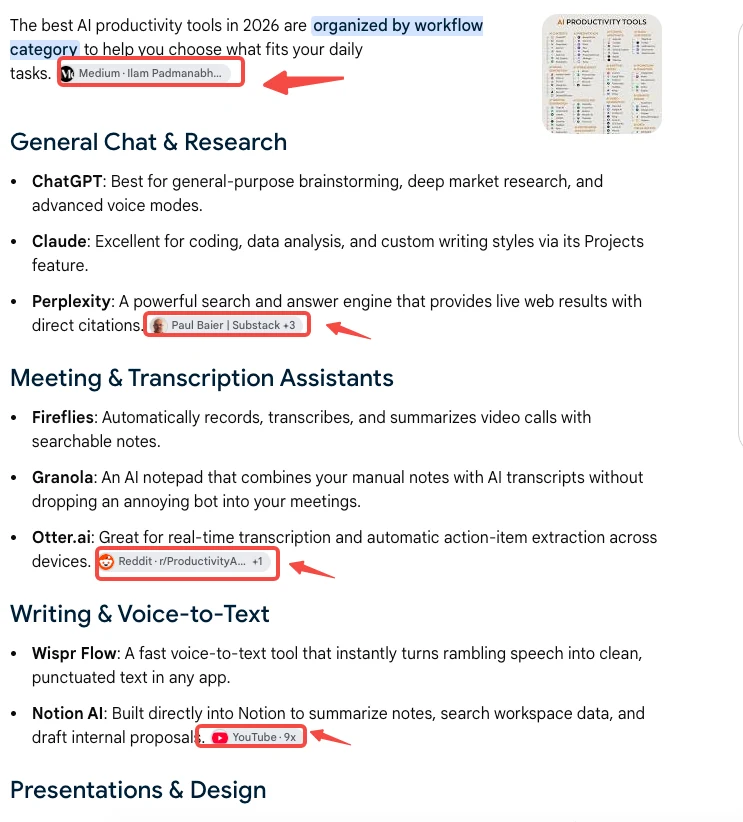
For example, if you ask an AI, “what is best AI productivity tool?” and the answer includes links, footnotes, or source cards next to certain statements, those are citations.
They may point to sources like Medium, Substack, Reddit, or YouTube.
That means the AI used those pages or content sources when building the answer.
So what is AI mention?
What is AI mention?
Mention means your brand name appears inside the main answer text.
Using the same example, if the user asks “what is best AI tool?” and the AI answer includes your brand name in the body of the response, that is a mention.
So mention looks at whether the brand entered the answer.
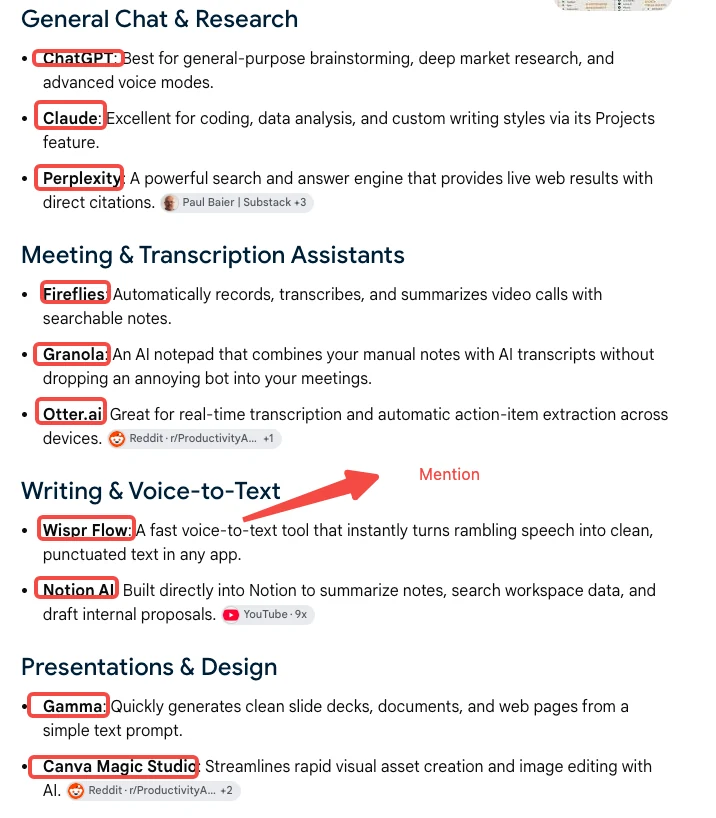
For example, if you ask an AI, “what is best AI productivity tool?” and the answer mentions ChatGPT, Claude, Perplexity, Wispr Flow, or Notion AI in the text, those are mentions.
It checks whether the brand appears in the AI answer itself, not whether there is a link next to the answer.
The key point is that citation and mention are not the same thing.
Many people mix them together and assume that if a website is cited, the brand was also mentioned.
That is not how it works.
Citation means the website was used as an information source. Mention means the brand name appeared in the answer text.
Why citation does not equal mention
In many cases, your website can appear as a citation, while your brand does not appear in the main answer.
For example, your website may publish a listicle that covers many brands.
When the AI answers a user question, it may use that article as one of its sources. So you get the citation.
But the brands mentioned in the final answer may not be your own brand. They may be other brands from the article.
In that case, your website was cited, but your brand was not mentioned.
Let’s look at an anonymized data.
The data comes from ChatGPT and Google AI Overview. The time range is July 4, 2026, to August 16, 2026. Each platform has 2,804 U.S. records. The industry is AI software and hardware.
| Platform | Anonymous brand | Mention rate | Cite-site rate | Both at the same time |
|---|---|---|---|---|
| ChatGPT | Brand B | 1,147 (40.9%) | 393 (14.0%) | 262 (9.3%) |
| Google AI Overview | Brand B | 837 (29.9%) | 269 (9.6%) | 191 (6.8%) |
In this data, Brand B was mentioned in 40.9% of ChatGPT answers, but its website was cited in only 14.0% of records.
Records where both happened at the same time made up only 9.3%.
In Google AI Overview, Brand B’s mention rate was 29.9%. Its cite-site rate was 9.6%. Records where both happened at the same time made up only 6.8%.
So mention and citation are not the same metric.
It helps to split the records into four outcomes rather than two rates.
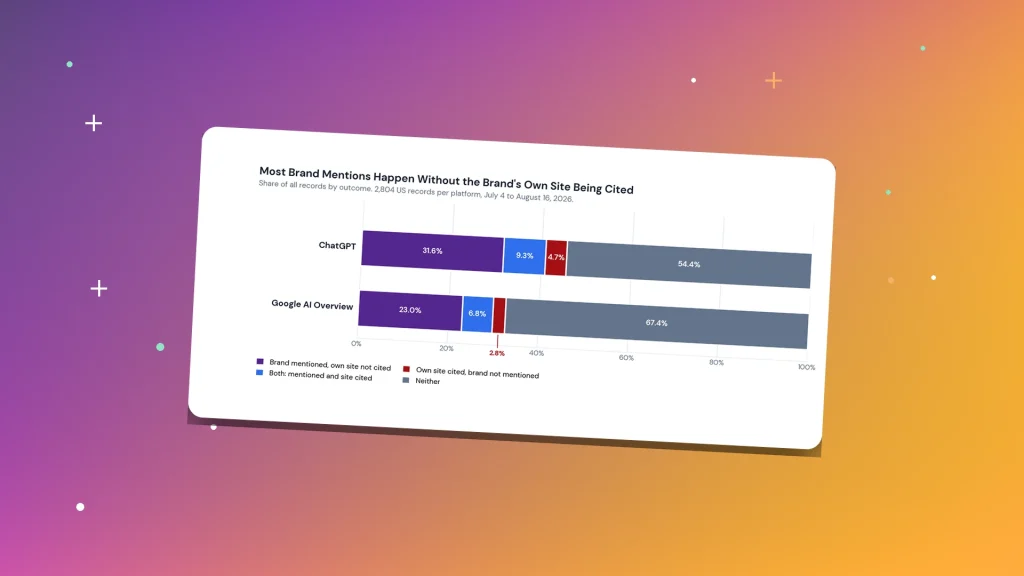
For ChatGPT, 31.6% of records mentioned Brand B without citing its site, 9.3% did both, 4.7% cited the site without mentioning the brand, and 54.4% did neither. Google AI Overview came out at 23.0%, 6.8%, 2.8% and 67.4%.
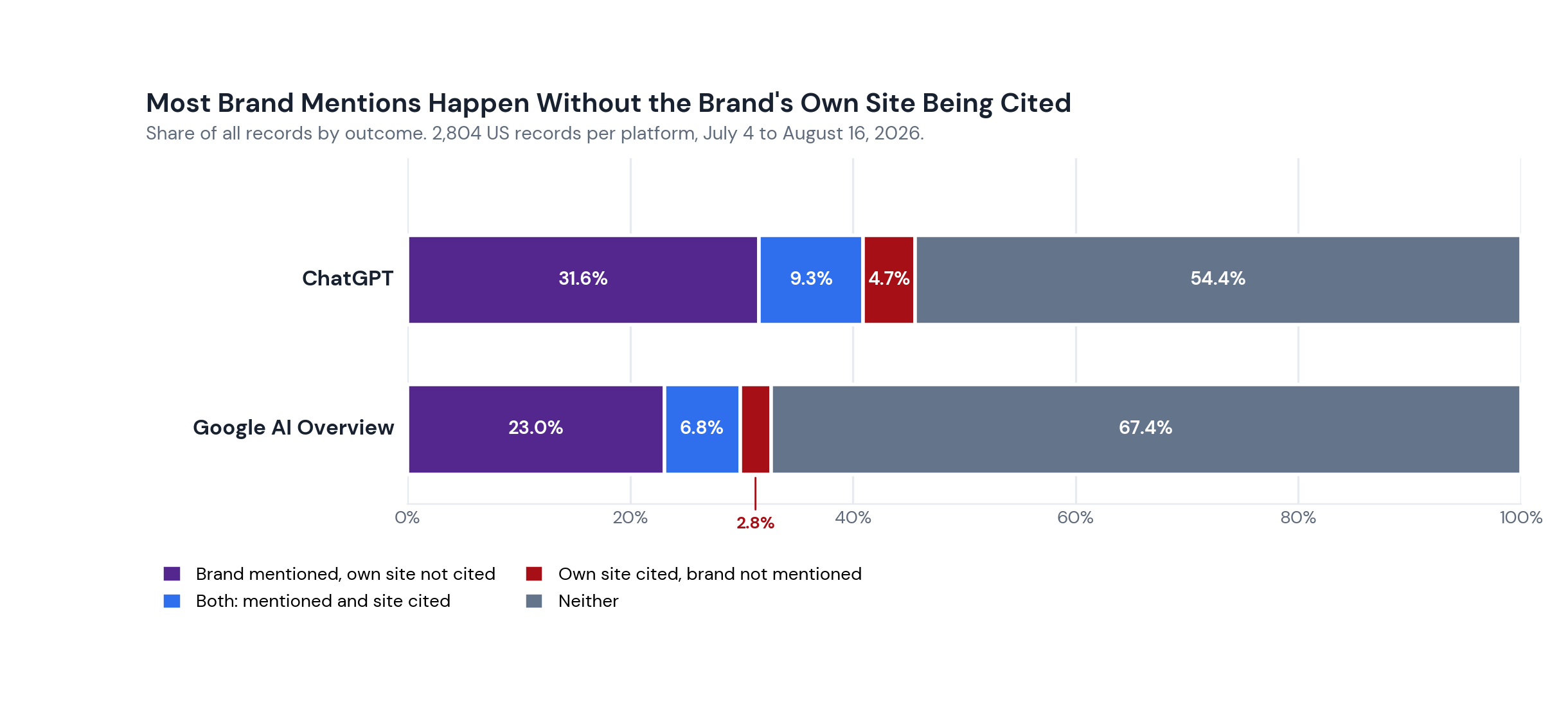
Read across those four cells and the gap is not symmetric.
When Brand B’s site was cited, the brand was also mentioned 66.7% of the time in ChatGPT and 71.0% of the time in Google AI Overview. A citation usually did arrive with a mention.
The reverse was much weaker. When the brand was mentioned, its site was cited only 22.8% of the time, and that figure was the same on both platforms.
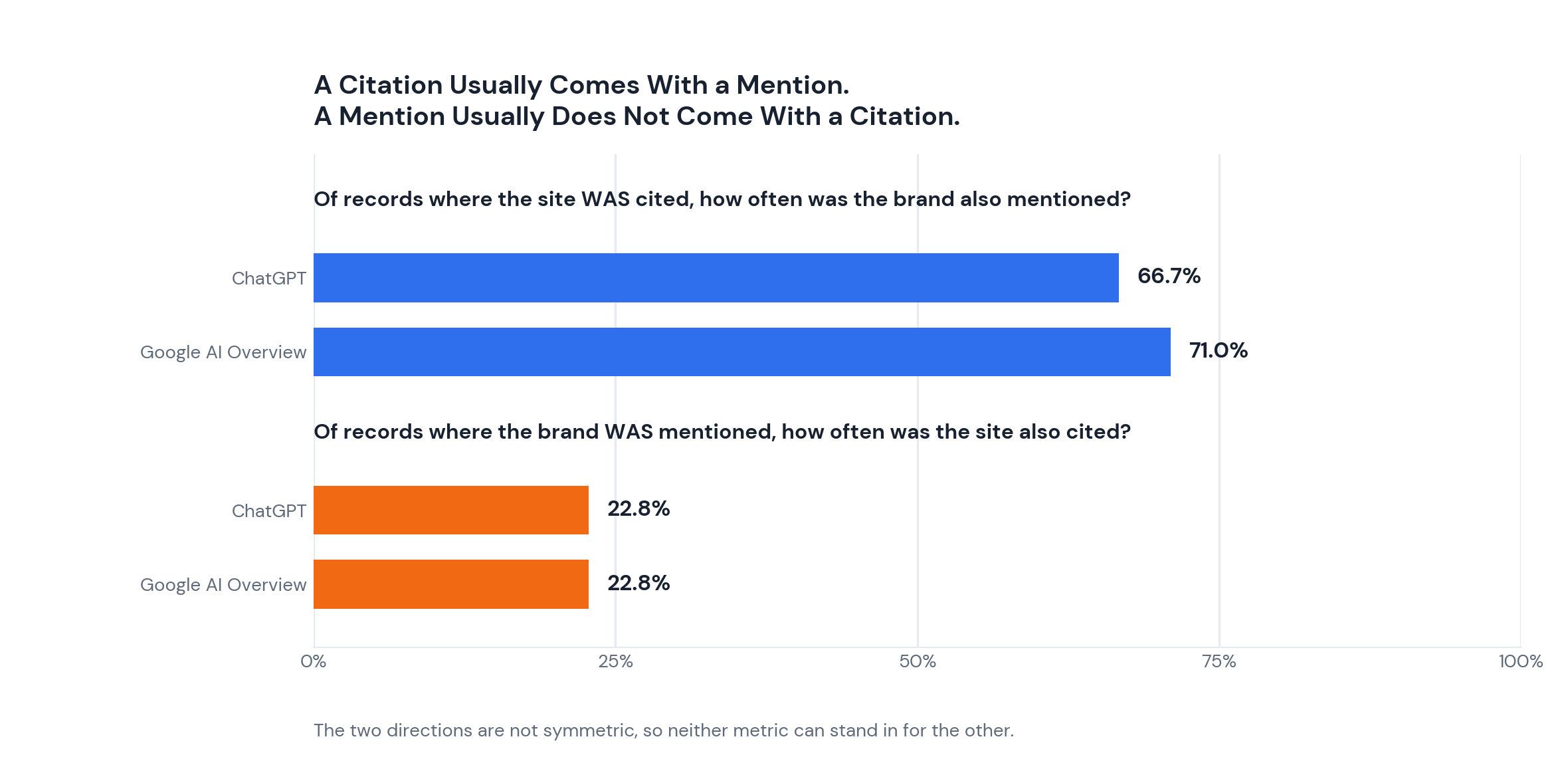
So the common case in this dataset is a brand being mentioned while its own site is not cited. The case where the site is cited but the brand is left out is real, but it was the smallest of the three positive outcomes, at 4.7% and 2.8%.
That still means the two metrics have to be tracked separately. It also means citation growth on its own says little about how often the brand reaches the answer.
There is another point here: Different platforms behave differently.
ChatGPT, Gemini, and Google AI Overview may handle citation and mention in different ways. Some platforms may give citations more often. Some may mention brands more often in the answer text.
So if we want to analyze the data later, we cannot look at only one platform, and we cannot look at only one metric.
Take the same anonymous brand across the two platforms. Every rate was lower in Google AI Overview: mention fell from 40.9% to 29.9%, cite-site from 14.0% to 9.6%, and both-at-once from 9.3% to 6.8%.
The one figure that held steady was the conditional rate. On both platforms, a mentioned brand had its site cited 22.8% of the time.
So the same brand can post different citation and mention numbers on different platforms.
So we should not use one platform’s data to judge total AEO performance. You need to look at ChatGPT separately, Gemini separately, and Google AI Overview separately.
Then you need to see whether the same brand is only cited, actually mentioned, or truly recommended on each platform.
A separate analysis we ran earlier showed what that smallest cell looks like in practice.
We wrote many listicle articles. These articles did increase citation, which means AI platforms were more likely to cite our website.
But in those cases the AI did not mention our brand in the answer.
It cited our article, and the brands in the answer were other brands. At that point, our content was not supporting our own brand. It was supporting competitors.
That outcome is not the average case in the tracking data above. It is the one worth checking for, because citation counts alone will not reveal it.
This is a key issue in AEO.
If you only look at citation, the strategy may look effective. Website citations increased, and AI started using our content. But when you look further at mention, you may find that your brand did not enter the answer. The brands that appeared may even be competitors.
If you chase citation without checking mention, you may send content value and trust signals to competitors.
What metrics should an AI content strategy track?
So when we build an AI content strategy, we should not look at only one metric.
1. Look at citation.
That means whether your website was used by the AI as a source.
2. Look at mention.
That means whether your brand appeared in the main AI answer.
These two metrics need to be separated.
If citation goes up but mention does not, your content may be used, but your brand has not entered the AI’s answer logic.
If both citation and mention go up, then your AI content strategy is closer to working.
How should we judge AEO performance?
Overall, AI citation is a valuable metric, but it is not the final goal.
The final question is not only whether AI cited your website.
The final question is whether AI placed your brand inside the answer that users actually see, trust, and may click.
If a content strategy can increase citation but cannot increase mention, it needs to be reviewed.
And if it helps competitors get more exposure in AI answers, the problem is even bigger.
So when you work on AEO or GEO next, do not only ask: was our website cited?
Keep asking:
Was our brand mentioned?
Was our brand recommended?
Is AI using our content to support someone else’s brand?
Only after these questions are separated can the AI content strategy stay on the right track.

Written by
Marketing enthusiast with a passion for SEO and Generative Engine Optimization (GEO). I believe SEO and GEO are ultimately about running experiments, testing hypotheses, learning from data, and building repeatable strategies that drive sustainable growth. I'm passionate about turning insights into practical frameworks, scaling what works, and continuously exploring how AI is reshaping search and digital marketing.