DoubleX Talk
A channel can be easy for an AI system to retrieve and still be a weak citation source. That is why I would not start creator outreach with subscriber count or a familiar name.
The decision depends on two questions: can this creator enter the retrieval pool, and is the content focused enough to support a citation once it gets there?
The dataset covers 64 YouTube channels monitored in Google AI Overviews. It supports a screening model, not a universal ranking rule.
The model starts with the job.
A two-stage screen
Use a two-stage screen:
1. Build a broad candidate pool around the jobs, questions, and formats relevant to the category.
2. Gate candidates on retrieval potential.
3. Prioritize focused channels using format, audience, and citation signals.
4. Test the shortlist against a fixed set of AI-search questions before expanding outreach.
Retrieval tells you whether a video enters the candidate pool. But entering the pool is only the first step. Citation tells you whether the video becomes evidence in the answer. I treat retrieval as the first gate, not the final ranking.
Retrieval and citation are different jobs
When a user asks a question, an AI Overview may move through several selection stages:
User question
→ Video enters the retrieval pool
→ Some retrieved videos are selected as citations
→ Some cited videos are reflected in the answer
Retrieval measures how often a video appeared in the candidate pool for the monitored questions. Citation measures whether that video was selected as evidence. Here, median `Citations/Retrieval` is the citation-efficiency measure. Put simply, it estimates how often a retrieved video became a cited source.
Citation efficiency is not traffic, influence, creator quality, or recommendation.
Retrieval is discovery. Citation is selection.
A channel may be retrieved often because its titles and descriptions match common questions. A focused tutorial may appear less often but provide a clearer answer to a specific task. Score the two outcomes separately.
A practical screening workflow
The screen runs in five stages. The first two build and clean the candidate pool. The third gates on retrieval potential and sends weak candidates to a backup pool. The last two prioritize with citation signals and rank the shortlist for outreach.
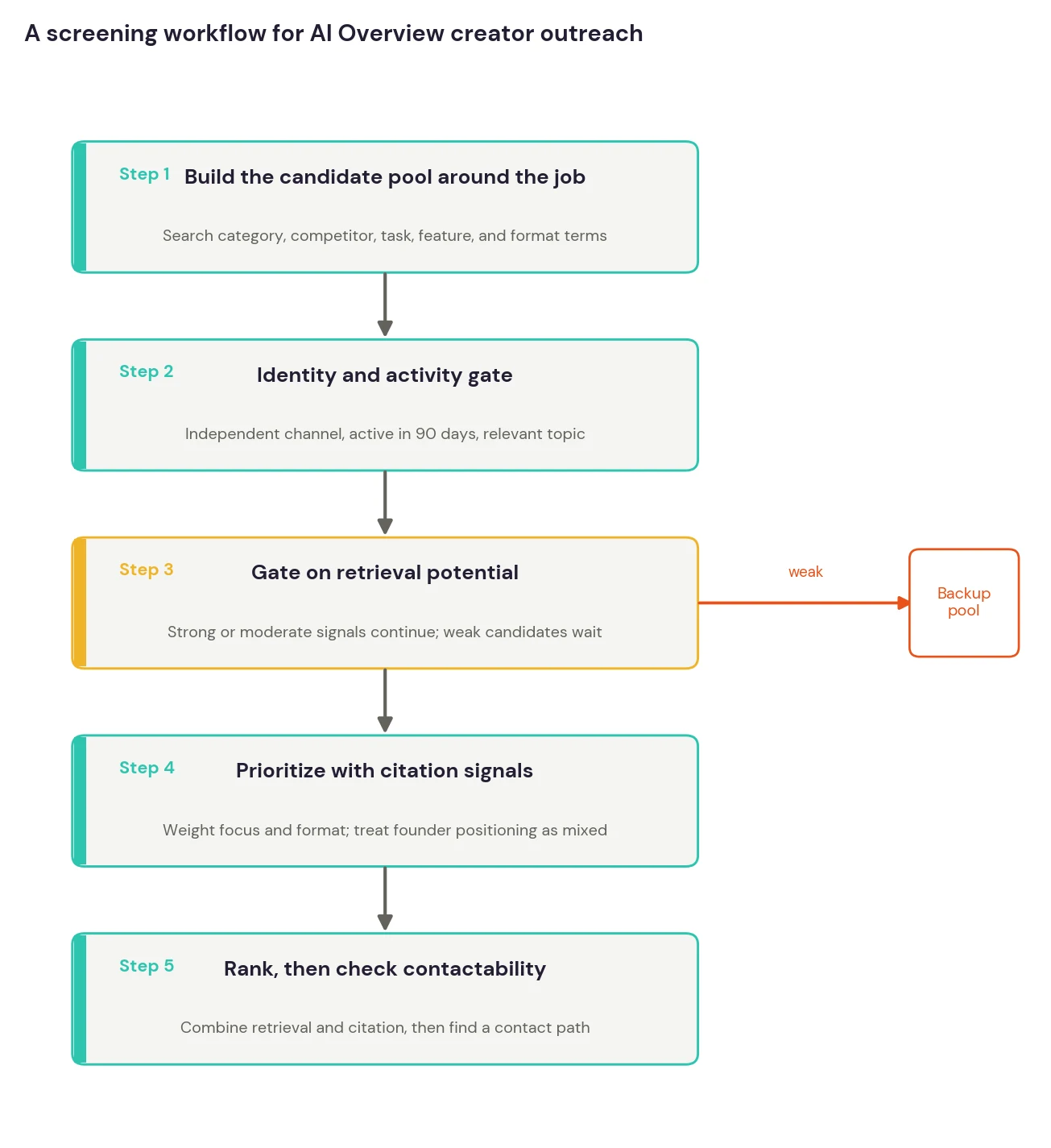
Step 1: Build the candidate pool around the job
Search across several keyword layers instead of relying only on the product category:
- Category terms: AI note taker, AI meeting assistant, meeting transcription software.
- Competitor terms: reviews, alternatives, and comparisons.
- Task terms: tools to summarize meetings, capture action items, search past conversations, or follow up after calls.
- Feature terms: speech-to-text, speaker identification, automatic summaries, CRM sync, or meeting search.
- Adjacent categories: voice recorders, conversation intelligence, meeting productivity, AI email assistants, and research tools.
- Format terms: best business software comparison, tools worth paying for, and “I tested every productivity app.”
Search this way to find creators who discuss the underlying job, not only the product category.
Search by job, not by brand.
Step 2: Apply the identity and activity gate
Before scoring content, check three basics:
1. Is the channel independent or run by a relevant third-party team?
2. Has it published recently, ideally within the last 90 days?
3. Does the content fit AI, software, productivity, technology, or business tools?
Keep candidates that meet all three in the main pool. A candidate that misses one can remain in a backup pool. Exclude vendor-owned channels when the goal is third-party outreach.
Step 3: Gate on retrieval potential
Use a simple first-pass screen:
- Strong: the bio contains AI, software, or productivity terms, or the dominant format is a multi-tool comparison.
- Moderate: the dominant format is tutorial or how-to content.
- Weak: none of those signals are present.
Do not score citation efficiency deeply before a channel has a credible path into the retrieval pool. If retrieval is rare, citation efficiency tells you little about the channel’s overall opportunity.
Weak signals stop here. The remaining candidates now need a data-based check: which formats create retrieval volume, and which ones turn retrieval into citations?
What the data says about retrieval
Multi-tool comparison channels had the highest median retrieval volume in the sample: 91 in the full sample and 45 after five leading channels were removed. Only four channels made up this group, so the exact median is not a benchmark.
Comparison content may create more retrieval opportunities. But it is not automatically the stronger citation format. In this sample, tutorials were more efficient on the citation side.
| Dominant format | Channels | Median Retrieval | Median Citations/Retrieval |
|---|---|---|---|
| Other / unclear | 11 | 45.0 | 1.286 |
| Tutorial / how-to | 6 | 26.5 | 1.216 |
| Multi-product listicle | 4 | 91.0 | 1.068 |
| Single-product review | 13 | 41.0 | 1.049 |
| Mixed | 10 | 22.5 | 1.000 |
| Personal / lifestyle | 18 | 31.5 | 0.897 |
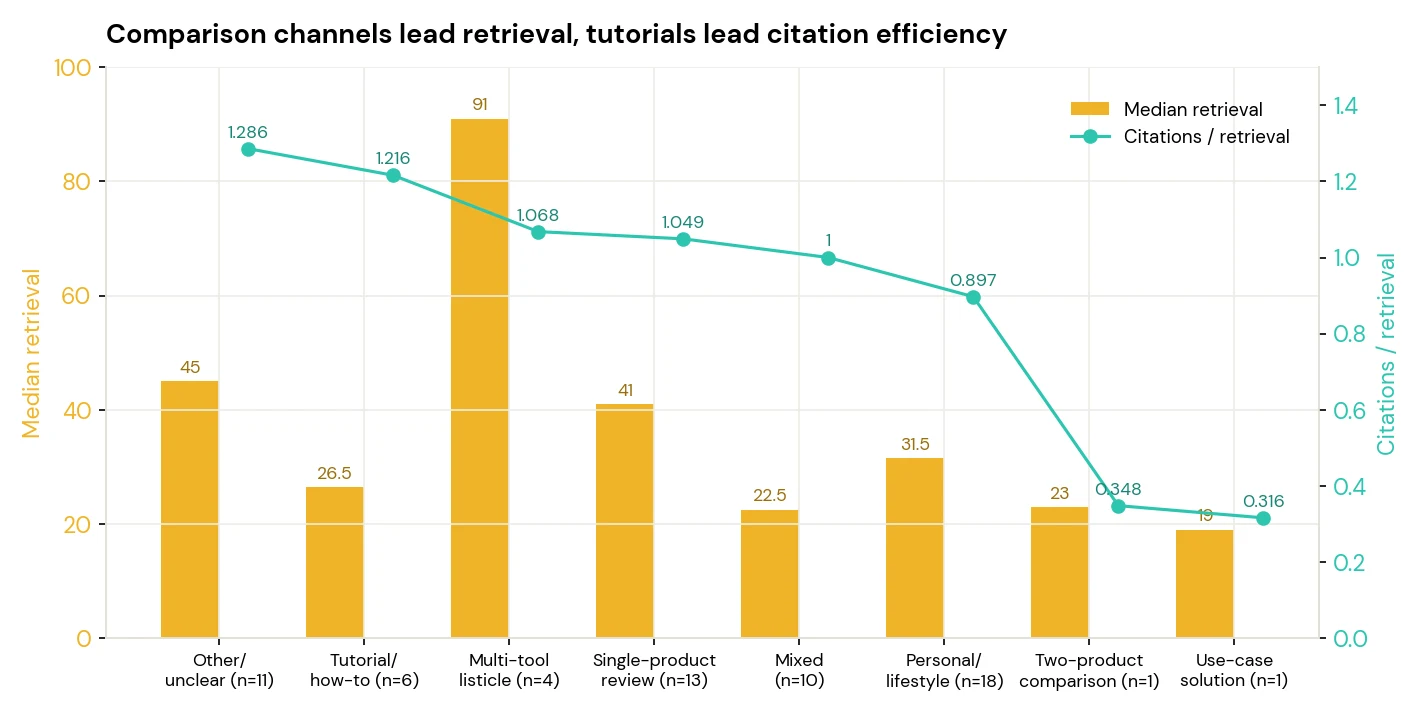
The comparison group had only four channels. Use format as a secondary signal, not as a ranking rule. That limitation makes topic fit the next useful filter.
Do not rank on format alone.
Topic fit also matters more than the broad label “AI channel.” Within the AI and software group, the subgroup medians were:
| Subtopic | Channels | Median Retrieval | Median Citations/Retrieval |
|---|---|---|---|
| Broad AI-tool reviews | 8 | 82.0 | 0.820 |
| Productivity and organizational software | 5 | 66.0 | 1.190 |
| Automation / no-code / business software | 4 | 48.0 | 1.269 |
| Creator and developer tools | 3 | 22.0 | 1.409 |
Creator and developer-tool channels were retrieved less often. Still, they had the highest citation-efficiency median in this subgroup.
What the data says about citation
Once a candidate clears the retrieval gate, use citation signals to adjust priority:
- Add weight for automation, no-code, creator-tool, or developer-tool focus.
- Add weight for a clear tutorial or how-to format.
- Reduce weight for broad channels that review every kind of AI tool without a clear focus.
- Treat founder-focused positioning as mixed. It may help retrieval, but it was not automatically positive for citation.
Founder-focused channels were retrieved often. But they had the lowest citation efficiency among the larger audience groups. Subscriber count also failed as a reliable gate. The smallest and largest subscriber bands both performed well relative to some middle bands.
Subscriber count may still matter for distribution or commercial reach. I would use it as a secondary outreach input, not as a discovery or quality threshold.
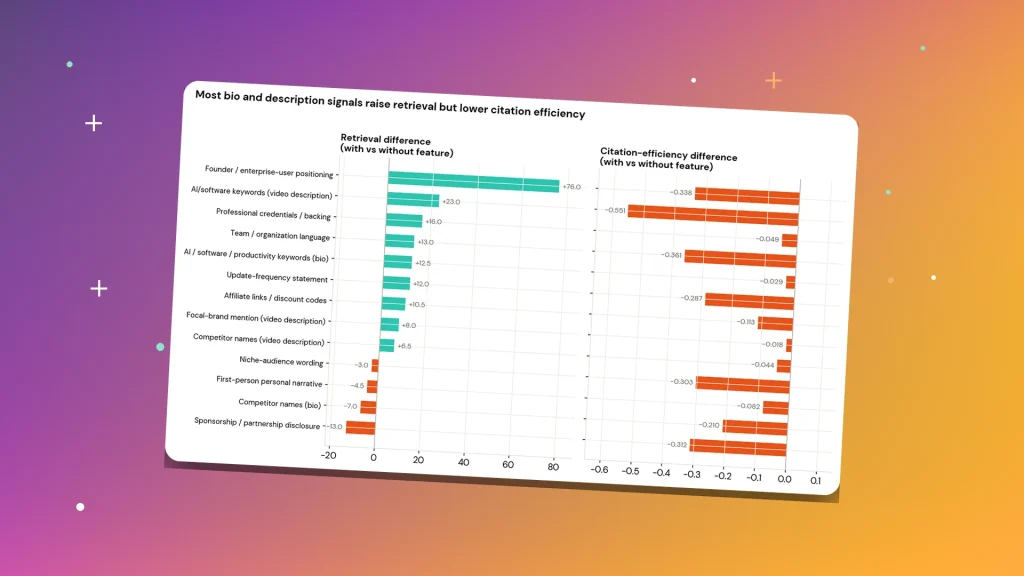
Searchable text shows the same split. AI, software, and productivity language was associated with higher retrieval. But several bio and video-description features had negative or weak citation-efficiency differences. Being findable is not the same as being useful evidence.
Reach and evidence can pull apart. The shortlist therefore needs two scores before outreach begins, not one blended view of creator quality.
Step 4: Rank and contact the shortlist
Rank candidates using two types of evidence:
1. Channels that perform well on both retrieval and citation should rank above channels that perform well on only one.
2. When candidates are otherwise comparable, larger comparison groups are more reliable than very small ones.
3. Expected citation volume should consider both retrieval volume and citation efficiency.
After four vendor-owned channels were removed, the working list contained 60 third-party channels:
- P0: 12 channels
- P1: 7 channels
- P2: 20 channels
- P3: 21 channels
Use the tiers to set outreach order. Do not treat them as a verdict on channel quality. A lower-tier channel may still be valuable when its topic fit, audience activity, or relationship path is strong.
Check contactability only after ranking. Review the About page and video descriptions for a public email address. No public email should not automatically remove a creator. Contact may need to start through a comment, social profile, or direct message.
Test the shortlist
The ranking is only a starting hypothesis. Build a small shortlist from several creator types and run it against a fixed set of relevant AI-search questions. Compare retrieval with citation. Do not use channel size as a proxy.
Size comes later.
I would expand outreach only after the shortlist shows that it can both enter the retrieval pool and supply useful evidence.
What the data does not prove
The data comes from an observational analysis of 64 channels monitored by a third-party AI search monitoring platform from April through June 2026 across approximately 100 fixed questions. It does not establish a universal ranking rule for YouTube creators or AI Overviews.
Several findings rely on small groups. The multi-tool comparison result came from four channels, and some citation-efficiency comparisons covered only five to ten channels. The exact medians are useful for sorting this sample, not for setting a benchmark.
The data cannot show that a bio keyword, tutorial format, or topical focus causes retrieval or citation. Those features may travel with content completeness, relevance, authority, or other factors that were not isolated.
Start with this screen. Test it against live AI-search questions, then revise the ranking rules as the sample grows.

Written by
Marketing enthusiast with a passion for SEO and Generative Engine Optimization (GEO). I believe SEO and GEO are ultimately about running experiments, testing hypotheses, learning from data, and building repeatable strategies that drive sustainable growth. I'm passionate about turning insights into practical frameworks, scaling what works, and continuously exploring how AI is reshaping search and digital marketing.