DoubleX Talk
A page can earn an AI citation and still fail to earn a brand mention or recommendation. In some cases, the brands it mentions may benefit instead.
The decision is whether those listicles help the focal brand enter the answer. They cover multiple products and match commercial queries, but that does not tell us which brands the answer will mention.
I would not prioritize them on query fit alone. I would first check whether the pages actually mention the brand and whether AI answers cite them.
This analysis tests two parts of that assumption:
1. Does publishing more Best content make the focal brand more likely to be mentioned in AI answers?
2. Does publishing more Best content make the focal brand’s webpages more likely to be cited as sources?
Mention, Citation, and Recommendation answer different questions. A team can increase first-party listicles without increasing third-party pages that mention the brand, or gain citations without proving that users prefer the brand. Visibility is not preference.
Key findings
- In both Google AI Overviews and ChatGPT, listicle pages generally produce fewer brand mentions than comparison and alternative pages.
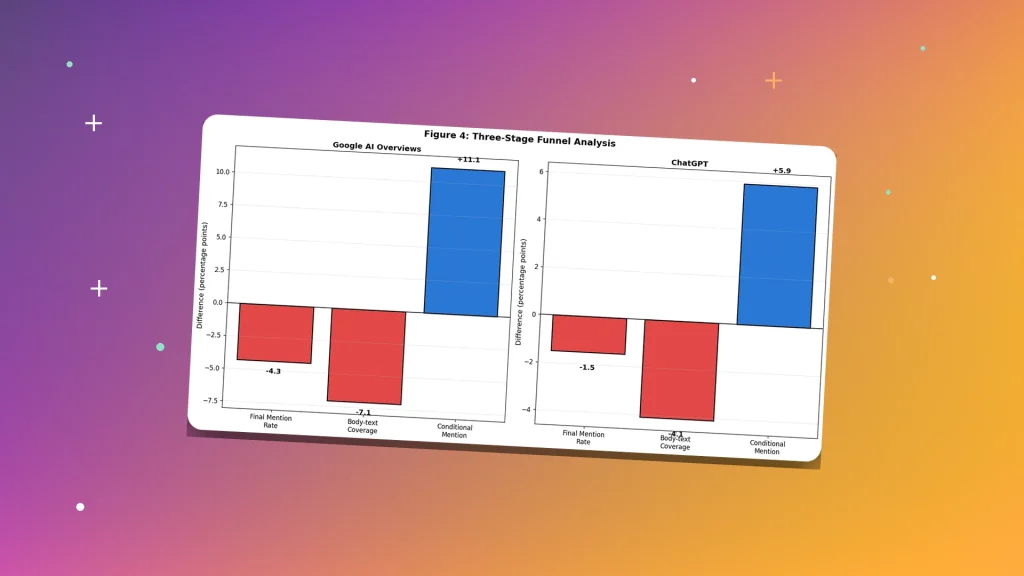
- In this dataset, the largest observed gap appears before the AI answer is generated: whether the brand appears in the body text of the source page at all.
- When a brand appears in the body text, it is mentioned in the AI answer more than 90% of the time across most brands, angles, and models.
- Only 3.8% to 12.0% of sampled third-party pages mentioned the focal brand in their body text, compared with roughly 30% to 78% for competitors.
- Listicle pages are cited at least once only about three percentage points more often than other angles in the raw data. After controlling for website-level differences, that advantage disappears or reverses.
These findings do not show that every listicle will underperform. They show that listicles do not have the stable mention or citation advantage needed to justify prioritizing them for the focal brand.
“Best” content may still support category coverage. The current data does not show a reliable advantage for either AI mentions or citations.
A citation is not the same as a recommendation
These terms describe different outcomes.
Mention rate is the share of AI answers that mention a brand in the answer text.
Citation rate is the share of webpages that appear as referenced sources below an AI answer.
A webpage can be cited without mentioning the brand, and a brand can be mentioned without the source being cited. These outcomes do not move together. Recommendation is related, but it was not measured here and none of these signals tells us whether users would choose the brand.
For analysis purposes, we separate the Mention result into two observable stages:
The source page mentions the brand in its body.
The page enters the body-text coverage set.
The analysis records whether the AI answer mentions the brand.
Each stage requires a different response. Publishing more first-party content does not address the third-party coverage gap.
What would count as a real prioritization advantage?
The analysis treated an angle as a priority only when it cleared four tests. These tests separate a repeatable advantage from a gap that appears only in one slice of the data.
- The difference was at least five percentage points.
- The 95% confidence interval did not cross zero.
- Google AI Overviews and ChatGPT showed the same direction.
- The result remained after controlling for the effect of large websites.
The analysis combined two sources. One was a webpage-level table of Google AI Overview and ChatGPT results, with URLs, domains, titles, content angles, brand mentions, and citation data. The other was a page-text sample used to check whether each page mentioned a brand in its body.
In this analysis, “Best” refers to the listicle angle, including “Best” and “Top” pages. The main analysis compared three editorial angles:
- Listicle: “The 10 Best AI Note-Taking Tools”
- Comparison: “Focal brand vs. Competitor 1”
- Alternative: “The Best Alternatives to Product X”
When calculating the focal brand’s mention rate, focal-brand-owned webpages were excluded to prevent inflation from first-party pages.
The source material omits the collection period, page counts, and sample sizes per model. The results may not generalize broadly.
For the focal brand, Best content shows no stable mention advantage
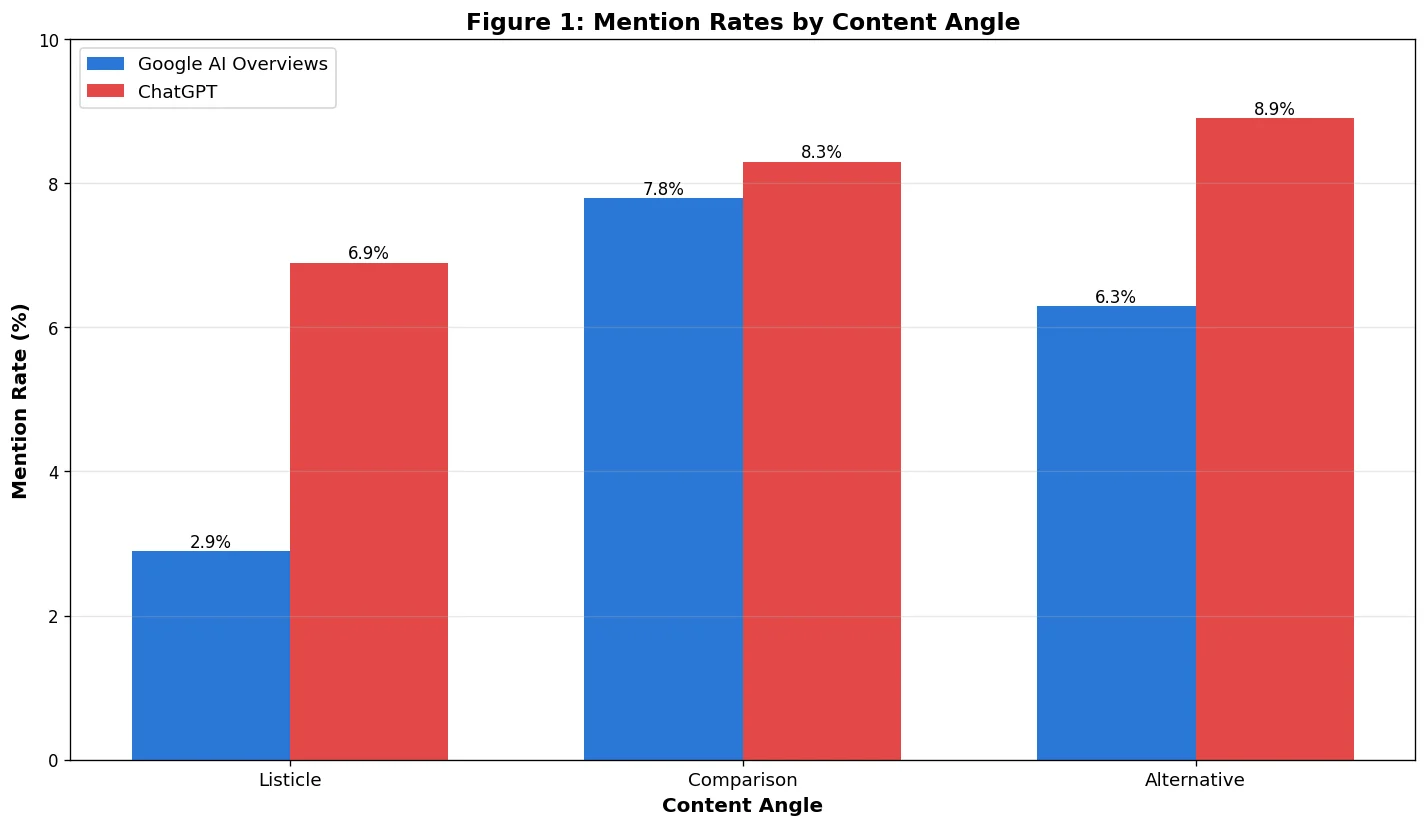
Listicle content had the lowest observed mention rate for the focal brand in both models.
Listicles started behind the other two angles in both models. That result needs a broader check before it can guide the focal brand’s content plan.
That result alone is not enough to establish a general pattern. The focal brand’s sample and coverage profile are unusual. The next question is whether competitors show the same direction.
The pattern is not unique to the focal brand
Across six brands, the same broad pattern appears. In Google AI Overviews, every brand had a lower mention rate in listicle content than in its own comparison and alternative content. ChatGPT showed the same pattern for most brands, with Competitor 5 as the exception.
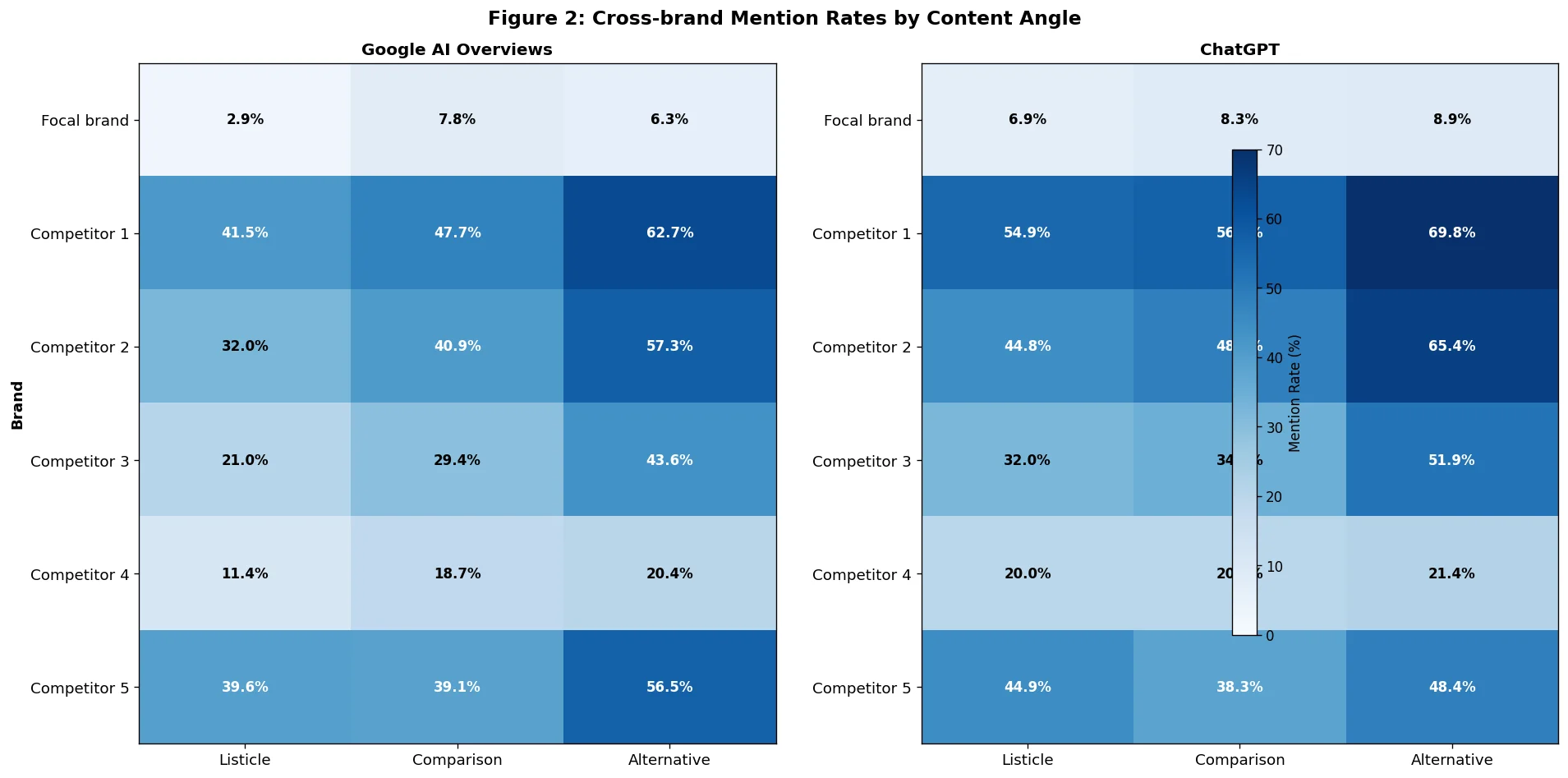
When listicle pages were compared with the combined comparison-and-alternative group, the difference was approximately:
- 10.3 percentage points lower in Google AI Overviews
- 2.3 to 2.4 percentage points lower in ChatGPT
The page-weighted and brand-equal-weighted calculations were almost identical. One large brand is therefore unlikely to explain the gap by itself.
Across six brands, listicle pages showed lower mention rates than comparison or alternative pages in most cases. That does not mean every listicle will underperform. It means listicles do not have the stable mention advantage needed for this goal.
Where does the visibility gap actually appear?
The page-text sample helps separate the two possibilities: is the gap caused by what happens after a page mentions the brand, or by whether relevant pages mention it at all?
For Google AI Overviews, the share of sampled pages whose body text mentioned the focal brand ranged from 3.8% to 12.0%. For the competitor group, the corresponding figures ranged from approximately 28.0% to 77.9%, depending on the competitor and angle.
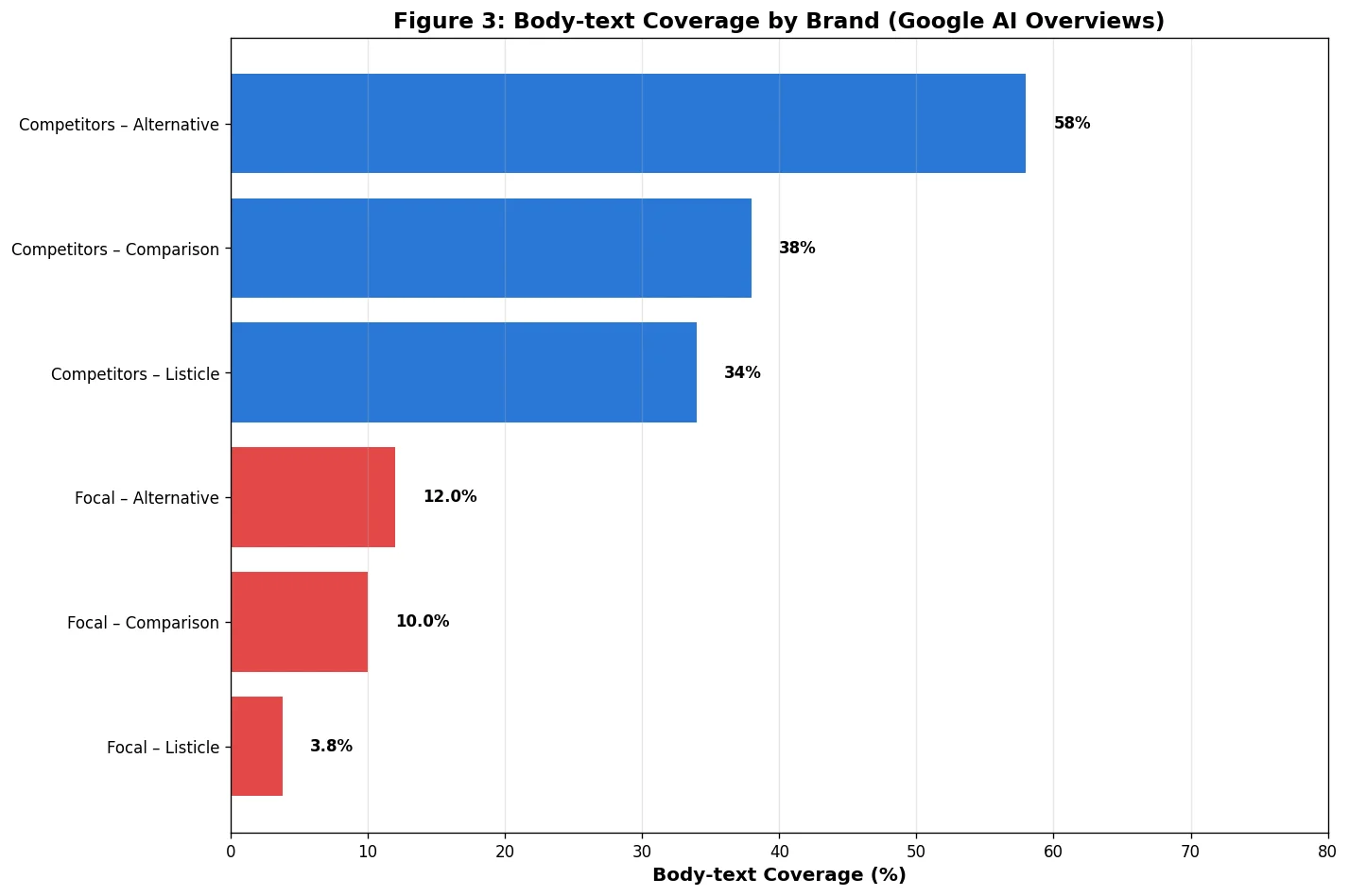
The focal brand’s main problem is not what happens after a page mentions the brand. It is that too few relevant third-party pages mention it at all.
The gap appears earlier.
The first problem might require better positioning, clearer evidence, or stronger page-level relevance. The second requires increasing the number and quality of third-party pages whose body text includes the brand.
Once a page mentions the brand, the angle matters much less
That finding moves the analysis to the next stage: what happens after a page has already mentioned the brand? Next, the analysis kept only pages whose body text already mentioned the brand.
Across most brands and angles, the conditional mention rate was above 90% in both models. For the focal brand, the sample was small. Only four to nine pages appeared in each cell, so individual percentages should not be overinterpreted.
The cross-brand pattern shows that once the brand appears in the body, AI systems usually mention it. The larger gap is at coverage, not at the mention stage.
Coverage is the problem the team can address first. The data does not prove that body-text coverage causes every mention, but it places the clearest gap before the answer-generation stage.
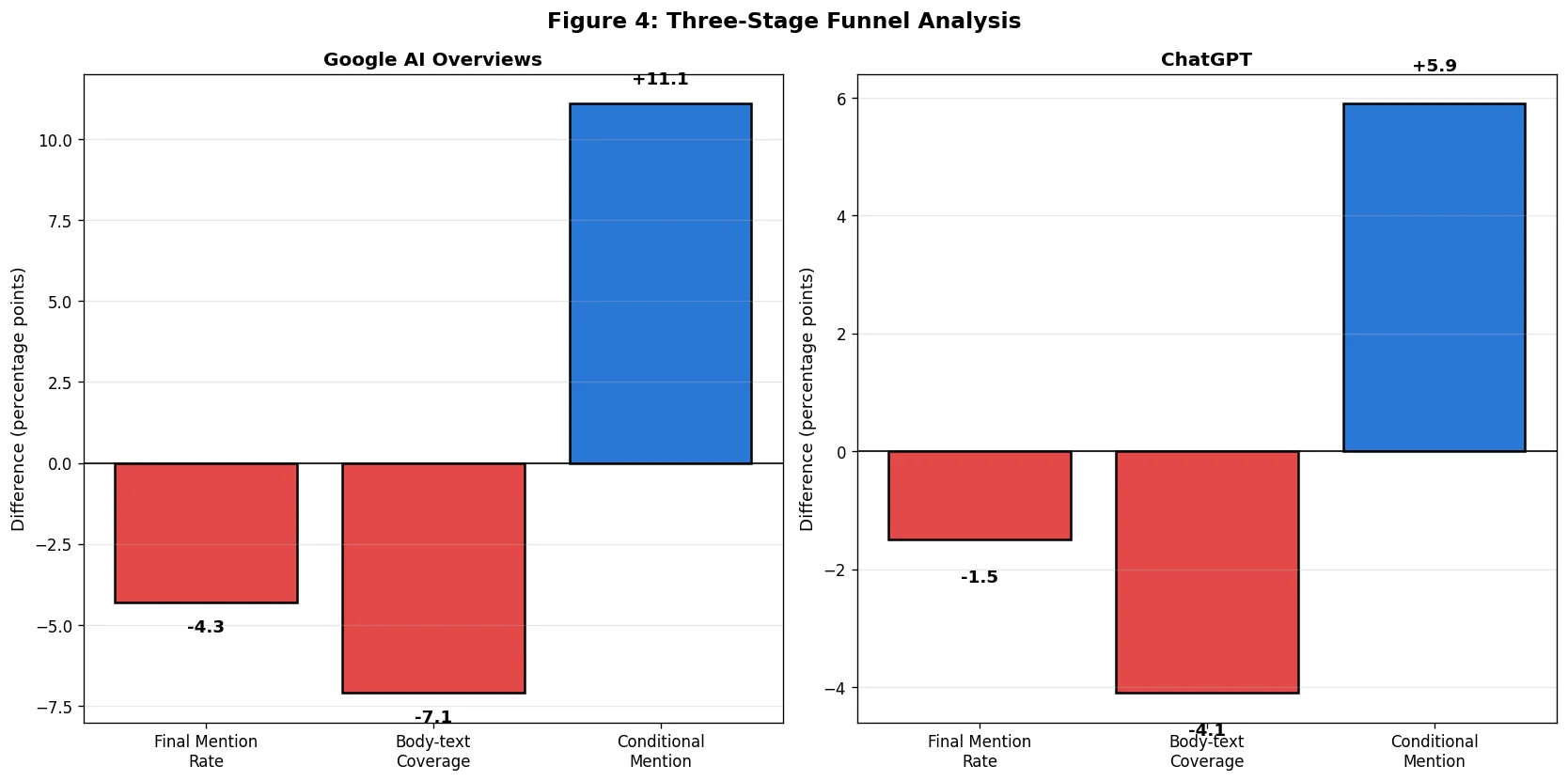
The conditional differences are not reliable estimates. The focal brand’s sample is too small. More stable: body-text coverage is low, but conditional mention rate is high.
That resolves the mention question. But citation is a separate test.
Listicle pages do not have a stable citation advantage
The raw citation results look slightly more favorable for listicles:
| Model | Listicle | Comparison | Alternative |
|---|---|---|---|
| Google AI Overviews | 41.3% | 38.0% | 38.4% |
| ChatGPT | 39.2% | 37.4% | 30.2% |
Listicle pages were cited at least once about three percentage points more often. But citation depth did not show a consistent advantage. The raw citation rate therefore needs the same control checks as the mention result:
| Model | Listicle | Comparison | Alternative |
|---|---|---|---|
| Google AI Overviews | 1.25 | 1.11 | 1.33 |
| ChatGPT | 1.33 | 1.08 | 2.17 |
When controlling for website-level effects, the advantages were not as large as the raw numbers suggested:
| Method | Google AI Overviews: listicle minus other | 95% confidence interval | ChatGPT: listicle minus other | 95% confidence interval |
|---|---|---|---|---|
| Page-level calculation | +3.1 points | [-0.6, 6.7] | +3.2 points | [-1.0, 7.5] |
| Website average | +2.2 points | [-2.9, 7.3] | -2.5 points | [-7.9, 3.0] |
| One page per website | +0.2 points | [-5.8, 6.2] | -3.0 points | [-9.5, 3.4] |
| Excluding first-party pages | +2.7 points | [-1.0, 6.4] | +3.4 points | [-0.9, 7.7] |
| Excluding angle-mixed pages | +5.2 points | [0.9, 9.5] | +5.5 points | [0.9, 10.2] |
The raw differences are not statistically significant. Excluding angle-mixed pages clears both thresholds, but the result changes with classification and disappears under website-level controls. The evidence is too sensitive to the specification to support a stable advantage.
The listicle sample may concentrate on large, authoritative websites. These sites get cited regardless of content angle.
The raw advantage is unstable and cannot support a strategy.
Limitations
This is an observational analysis, not a causal experiment. It identifies relationships between content angles and AI outcomes, but it does not assign a cause.
Body-text coverage is sampled, not web-wide, and the focal brand’s sample is small. Results may not generalize.
The brands tracked do not represent all competitors, and the analysis covers three angles only. Content format is out of scope. Mentions and citations do not connect to business outcomes.
Use these findings for content prioritization, not as proof of incremental business impact.
What should the content team do next?
Treat these actions as tests. They are not proven growth levers.
If the objective is to increase the focal brand’s mentions in AI answers, use the following sequence:
1. Build a third-party coverage target list.
2. Identify pages that mention Competitors 1, 2, or 3 but not the focal brand.
3. Prioritize comparison and alternative pages that already show evidence of being crawled or cited by AI systems.
4. Check whether each page is still maintained and whether an editor, author, or outreach path can be identified.
5. Pursue editorial updates, public relations, link acquisition, or direct outreach.
6. Recheck whether the pages now mention the focal brand in their body text and whether its mention rate changes in the relevant AI answers.
These actions address the observed body-text coverage gap more directly than publishing additional first-party listicles.
Do not prioritize Best pages for citations alone. Further analysis should examine website authority, ranking, update frequency, and crawl volume.
Keep the outcome definitions separate:
Citation ≠ Recommendation
Mention ≠ Preference
Visibility ≠ Business impact
Citation and Mention tell us where the brand appears in an AI answer or its source set. They do not tell us whether users will prefer or choose the brand.
Final decision
If the goal is to increase the focal brand’s AI mentions, do not prioritize Best content based on the current evidence. Listicles do not show a stable mention advantage. The main bottleneck is third-party body-text coverage.
If the goal is to increase citations of the focal brand’s webpages, the answer is also no. The small raw advantage disappears or reverses after website-level controls.
Best content can still support education and category coverage. But it should not be the focal brand’s first investment. Focus instead on high-value third-party pages already in AI crawl records that do not yet mention the brand.
My recommendation is to test third-party coverage before increasing the volume of Best content. The first test is coverage, not volume.

Written by
Marketing enthusiast with a passion for SEO and Generative Engine Optimization (GEO). I believe SEO and GEO are ultimately about running experiments, testing hypotheses, learning from data, and building repeatable strategies that drive sustainable growth. I'm passionate about turning insights into practical frameworks, scaling what works, and continuously exploring how AI is reshaping search and digital marketing.