DoubleX Talk
For months, my team kept asking the same question after every round of Reddit activity. Why did the brand show up in one AI answer and not another? Nobody had a reliable way to tell. The usual response is more activity, posting and commenting on repeat, which is a guess wearing the clothes of a strategy.
The real question underneath that guessing is simple to state and hard to answer:
Which lever explains why AI mentions a brand in one place and skips it in another, and which one should get tested first?
Answering that meant working through four things, in order. First, understanding exactly what has to happen for a mention to occur, and knowing where to even look. Then, understanding why AI favors what it favors, and deciding what order to test each variable in.
The tests below have not finished running, so there is no outcome data yet. What follows is that four-part thinking, plus the data points that changed our plan before we started.
The first piece – what actually has to happen for a mention to occur
AI does not mention a brand in one step.
Content has to clear a sequence of gates first. It has to sit somewhere AI actually draws from, and AI has to pull it in as a candidate source, then cite it explicitly, before the brand’s name has a chance to survive into the visible answer.
| Variable | What it means | Role in the chain |
|---|---|---|
| Coverage | Whether brand-mentioning content sits in the spaces AI actually draws from | Decides whether the brand enters the candidate pool |
| Retrieval | Whether AI pulls a piece of content into its candidate sources | Decides whether a piece is even seen by the model |
| Citation | Whether AI goes on to cite that content explicitly in its answer | Decides whether a seen source gets shown to the user |
| Brand mention | Whether the brand’s name survives into a cited source | Decides whether a citation actually becomes visibility |
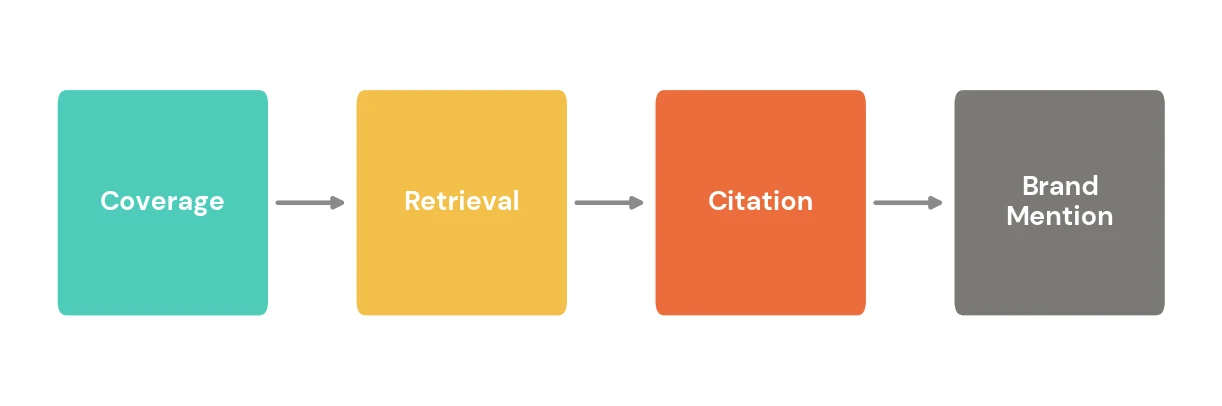
The reason to name these four separately is practical. Each is a different place a brand can fail, and each calls for a different fix. Treat “getting mentioned” as one lever, and there is no way to tell which stage is actually broken.
The second piece – knowing where to even look
Naming the four gates only matters once I know where to actually test them. Reddit is where I looked, and it earned that attention. I didn’t just treat it as one channel among many.
It carries first-person experience and side-by-side comparisons in a way most brand-owned content doesn’t. Competitors also show up naturally in the same threads.
A lot of what a model ends up citing there isn’t even the original post. It’s a comment buried in the replies. That is why the real unit of study is specific threads and comments, not “should we post here.”
Testing a variable only means something if it happens somewhere that matters, so before any experiment, I mapped which specific threads actually deserved that attention. A thread only earns it if it meets these conditions together.
- AI already retrieves it, so it has some baseline visibility.
- AI is willing to cite it, so it carries real weight once seen.
- Competitors already show up in it, so it is an accepted comparison context.
- The brand is still missing from it, so a real gap exists.
- It is actually about the categories we care about, not just loosely adjacent to them.
- It is still actionable. Comments are open, the discussion isn’t dead, and there’s no rule against a reply like ours.
A thread that clears most of these is worth acting on. One that only clears one or two is not, no matter how much traffic or attention it gets on its own.
Run an experiment on a random sample instead of this filtered set, and you mix strong opportunities in with weak ones. The test buries its own signal before it even starts.
It also helps to keep the test pool itself balanced. If every thread in a round happens to share the same topic, community, or age, a result can end up describing that one slice rather than the variable being tested.
The third piece – why AI cites some content and skips other content
Picking the right threads answers where to act. It doesn’t answer why AI favors some content over other content in the first place, and skipping that question makes it hard to explain any result once a test finishes.
In practice, AI tends to favor content that answers a question directly, takes a clear position, includes an explicit comparison, and reads as first-hand experience rather than marketing copy. Content that matches the phrasing of the question closely also seems to do better, which lines up with how retrieval behaved in our own data.
Before running an experiment, these preferences break down across three angles. Which topics keep showing up in the content AI cites. Which kinds of communities or threads keep getting pulled in. And in what surrounding context a brand’s name tends to survive once AI cites a source, since AI rarely keeps a brand around just because it appeared once.
Without this step, a test can only tell you that something worked, not why. That makes the result a one-off instead of something the next round can build on.
With a filtered pool and a working theory – testing still wasn’t simple
With a filtered pool of threads and some sense of why AI favors what it favors, the next step should have been picking a variable and testing it.
That turned out to be harder than it sounds. The obvious move is to test whichever gate is easiest to act on. In our data, that approach breaks down twice, with a third issue coming from the mechanics of the platform itself.
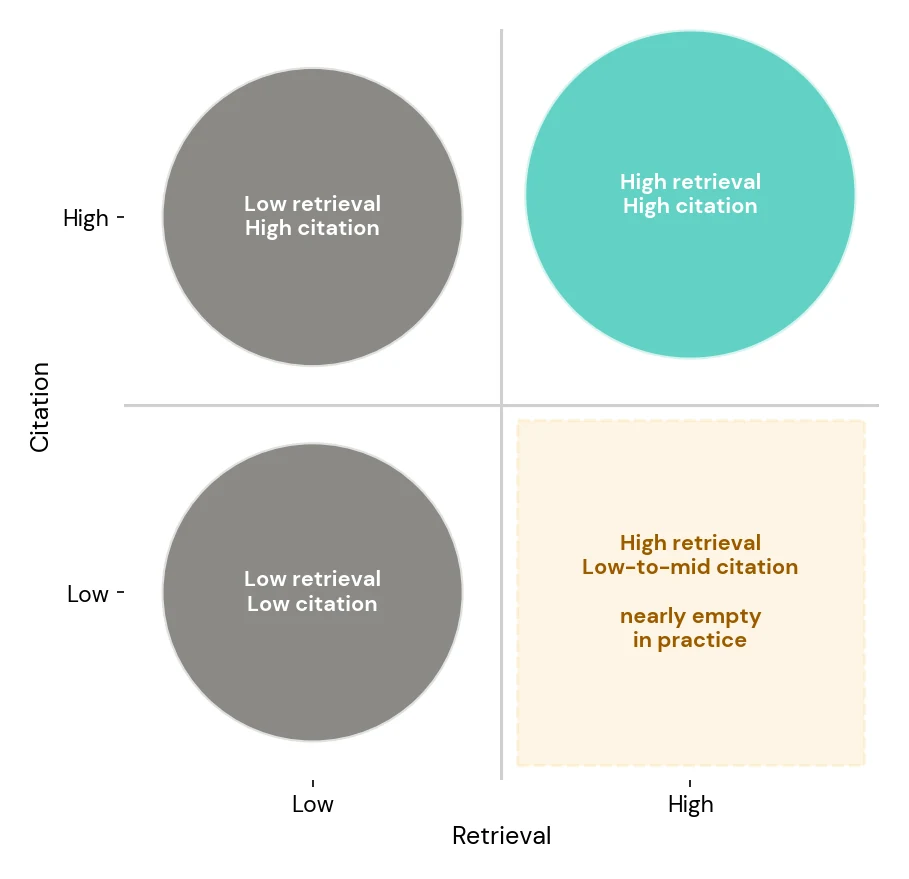
The first break is a correlation problem. Looking at our own content, pieces that AI pulls in often but rarely cites explicitly are almost nonexistent. Retrieval and citation tend to move together. Practically, that means we cannot isolate “does citation improve” while holding “does retrieval improve” fixed.
The second break is a measurement problem, and it showed up even before we ran anything. I pulled the questions that actually triggered each piece of content in our review set of 81 threads. One distinct question triggered twenty of them. Two to five questions triggered forty-two.
Only a handful needed more than that. Seventy separate questions triggered the single busiest thread alone.
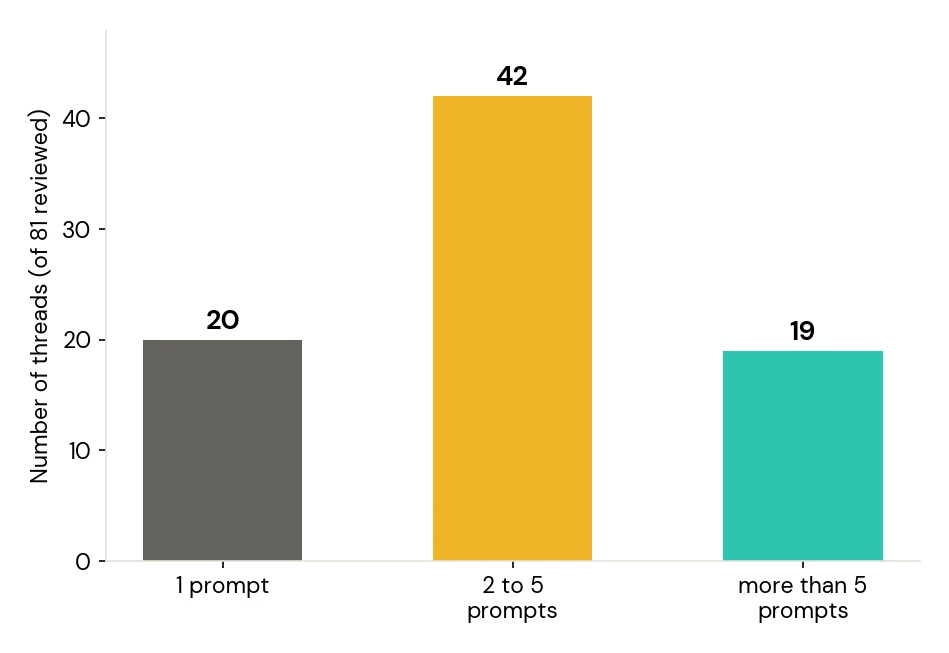
Put a single generic list of test questions against that spread, and most of the real activity falls outside it.
The third issue is that a single action rarely controls retrieval on its own, since it depends on model updates and how often the underlying content changes. I treat it as something to watch over time, not the lever for a first test.
The fourth piece – the order we are testing in
Once those three problems were clear, the last piece was sequencing.
We are running three rounds, in an order set by how close each variable sits to the final outcome, not by how easy each one is to execute.
| Round | Variable | Core question | Why this order |
|---|---|---|---|
| 1 | Citation, meaning source selection | Should we prioritize threads AI already treats as worth citing | Closest to the final outcome, decides where to act first |
| 2 | Brand mention, meaning context | How should we describe the brand once we are in the right place | Only worth answering after the right threads are chosen |
| 3 | Coverage, meaning scale | Does adding more threads still pay off | Scaling an unproven approach just scales the guesswork |
| Ongoing | Retrieval | Is content entering the model’s knowledge base over time | Watched throughout, not treated as a lever |
Round one – designing a test around a variable we can’t set directly
Citation and retrieval are properties of a piece of content, not something an action can set directly. The only thing fully within our control is whether we intervene on a given thread at all.
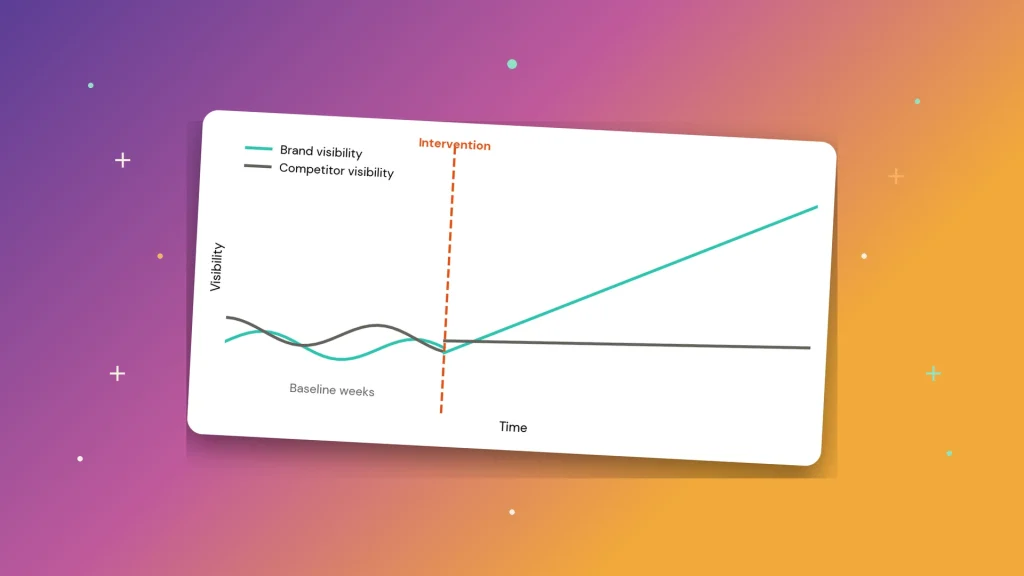
So the actual variable we test is intervention versus no intervention, applied across the whole pool of qualifying threads at once, comparing brand visibility before and after. I chose that over holding out a control group for the first pass, mainly because it is simpler to run and gives broader coverage while the goal is still exploratory.
A before-and-after design on its own cannot tell the difference between our own effect and background noise from a model update or a competitor’s own activity. Two checks help separate them.
We measure a baseline for a few weeks before anything changes, to see how much natural movement already exists. We also track competitor visibility on the same questions over the same window, so a rise in the brand’s visibility while competitors stay flat reads as a much stronger signal than a rise on its own.
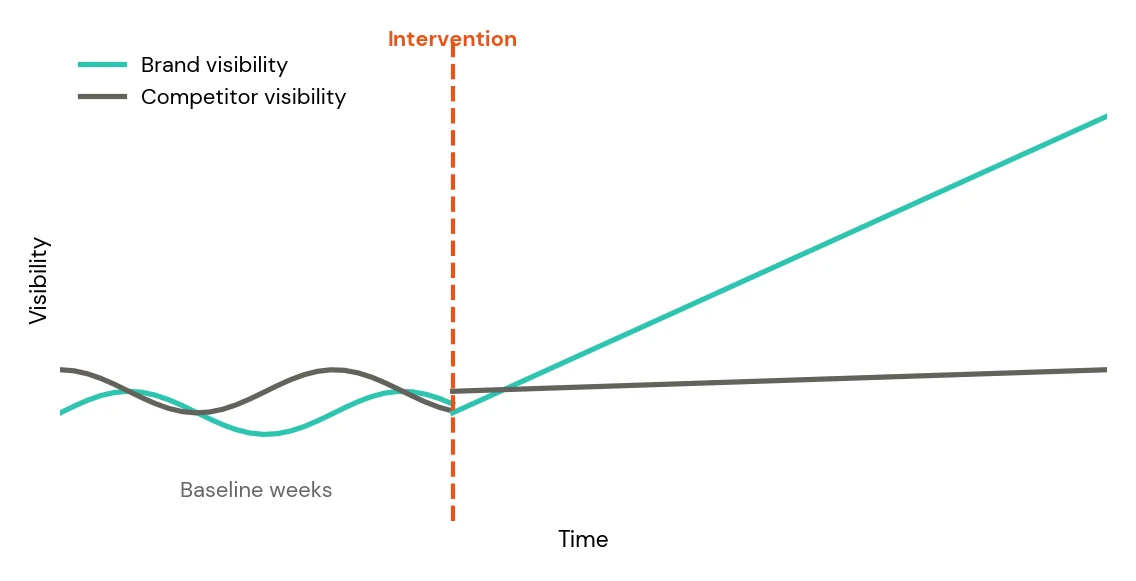
None of that holds if the test conditions themselves drift. The same models, language, region, and account state need to stay fixed for the whole round. Otherwise a change in visibility could just as easily be a change in what we’re measuring.
A stricter version of this design, with an actual held-out control group, makes sense to run later once the first pass points in a clear direction. It costs more to run properly, which is why it comes second, not first.
Round two – testing how the brand should appear
Picking the right thread only gets a brand into the room. The next question is how to describe it once it’s there, because a model can easily drop a name without context, and a reader can just as easily skip past it.
We are testing that by holding the thread and topic constant and only changing how the brand is written in.
- One version mentions the brand on its own.
- Another places it alongside the same competitors already present in the discussion.
- A third adds a specific use case on top of that.
Comparing these is less about finding the best sentence, and more about learning which kind of context a model is likely to retain once it has already decided to cite the source.
Overall visibility is not the only signal that matters here.
Whether the brand starts turning up in answers that used to be competitor-only, and whether it starts sticking to a specific use case rather than floating free of one, both point to a context that is actually working rather than just being present.
Round three – why scale comes last but seeding starts early
It is tempting to treat more content as the safest lever, since it is the one most fully within a team’s control. We are deliberately testing it last, once source quality and brand context are already reasonably well understood.
That said, “last” applies to judging whether to scale, not to every action tied to this variable. New posts take weeks to months before a model even notices them, and it never picks up many of them at all.
Waiting for the other two tests to finish before starting any new posts would waste that lead time for nothing. So we seed new content early and in small batches, in parallel with the other tests, while the decision about whether to scale it stays for later.
These two actions are also easy to confuse with each other. Adding a comment to an existing high-value thread is a source-selection action, since it chooses where to show up rather than creating a new place. Publishing a new thread is the one action that actually expands where a brand can appear, which is why it is the cleaner way to isolate the effect of scale on its own.
When we do evaluate this round, the target should be a share of the qualifying thread pool, not a fixed count. The pool itself is limited once we filter it for quality.
Moving from a quarter of it covered to half, then to all of it, gives a clearer read than aiming at an arbitrary total.
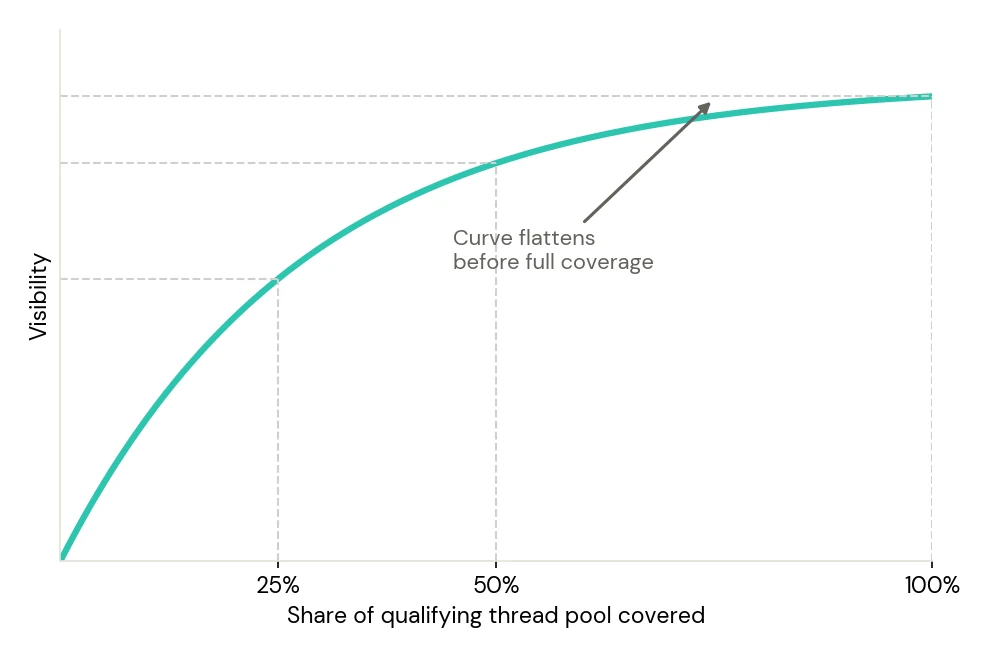
Watch whether visibility keeps rising in step as coverage grows. If the increase flattens well before full coverage, that is a sign the real limit has shifted from how much content exists to something about its quality or placement.
What all three rounds are actually judged against
We judge every round above against one shared yardstick.
That single outcome is visibility itself, meaning how often the brand actually shows up across a fixed set of questions and models. Retrieval, citation, and the variables above exist to explain why visibility moved, not to replace it as the result.
| Metric | Definition | Role |
|---|---|---|
| Visibility | Share of answers where the brand appears, across a fixed question set | The one outcome every round is judged against |
| Visibility change | Visibility after an intervention minus visibility before it | The basic result of a round |
| Effect size | The test group’s change minus the reference group’s change | Separates a real effect from background noise |
| Relative change | Change expressed as a share of the starting point | Lets you compare rounds that started from different baselines |
| Cost-adjusted score | Effect size weighed against the effort it took | Decides what’s worth repeating, not just what worked |
| Gap answer rate | Share of answers where a competitor appears but the brand does not | Maps where the opportunity actually sits |
The yardstick is only as good as the questions behind it
That shared yardstick depends entirely on the questions used to measure it, which is where the earlier fragmentation problem comes back in. The questions used to measure all of this are grouped by the kind of decision a person is making, rather than kept as one flat list.
| Cluster | What it covers |
|---|---|
| Recommendation | Early-stage list and best-of questions |
| Comparison | Direct alternative and versus questions, usually the most valuable for displacing an incumbent |
| Use case | Situational questions tied to when one option fits better than the alternatives |
| Role-based | Questions tied to a specific job or industry, kept smaller in number |
Keeping these groups mostly fixed across an entire test window matters as much as picking good questions in the first place. Swap the question set out partway through, and the before-and-after comparison stops meaning anything.
What this changes about how we test it
Coming back to the original question:
Which variable actually explains why AI mentions a brand?
A few practical shifts followed directly from the four pieces above.
- Test the variable, not the tactic. Posting, commenting, and replying are intervention types, not the thing being measured.
- Change one variable at a time and hold the rest steady. You can’t pin a result that moves two things at once on either one.
- Before splitting two things into separate tests, check whether the data can actually tell them apart.
- Build the question set backward from what triggers the specific content under test, organized by intent.
- Put scale last as a judgment call, even while starting the slow-moving parts of it early.
- Judge every round against visibility itself, not against the intermediate variable it was testing.
Where this is honest about its limits
None of the three rounds have finished running yet. There is no measured outcome or effect-size data, and I am not going to pretend otherwise.
The data points behind this piece come from one team’s own content and question set, in one market. They may not hold elsewhere, and I would not assume they do without checking.
The causal path we’re testing is also long. A comment has to lead AI to re-crawl a source, then cite it, before the brand name can survive into the visible answer. Early results should be read as directional, not as proof.
Visibility itself is also not the final word. Everything here treats it as the outcome to test against, but showing up in an answer more often is still one step short of whether that changes what a user actually decides. That question sits outside what this piece covers.
The problem was never the tactic
Looking back, the actual risk the whole time was spending effort before knowing which variable mattered, more than picking any single wrong tactic.
The safer next move is to run the first round and see whether the variable actually matters before scaling anything.

Written by
Marketing enthusiast with a passion for SEO and Generative Engine Optimization (GEO). I believe SEO and GEO are ultimately about running experiments, testing hypotheses, learning from data, and building repeatable strategies that drive sustainable growth. I'm passionate about turning insights into practical frameworks, scaling what works, and continuously exploring how AI is reshaping search and digital marketing.