DoubleX Talk
When my team started planning how to operate on Reddit for AI search, one belief kept coming up in conversations with other practitioners: casual, conversational posts are the ones AI tends to cite. It sounded plausible. Reddit runs on informal, first-person threads, so it seemed reasonable that ChatGPT would pull from them too.
I wanted to know whether the data agreed.
Two different outcomes matter here, and teams often blur them.
One is whether ChatGPT retrieves a post at all, meaning it pulls the post into the candidate sources behind an answer. The other is whether the post then gets cited, meaning it shows up as a link in the visible response. Plenty of posts do one without the other.
So I split the analysis into two parts.
Part A looks at what makes a post do well on both at once, the posts I will call golden. Part B looks at what maximizes retrieval on its own, which is the more basic form of visibility.
Both parts draw on 363 Reddit posts that ChatGPT had cited across 100 Best-class commercial prompts, collected over roughly 90 days between March and June 2026, in the United States and in English.
Key findings
- Of 363 posts, only 135 were high on both retrieval and citation. The rest were strong on one and weak on the other.
- Retrieval and citation agree on just three features: post age of 90 to 180 days, length over 300 words, and the presence of lists.
- They diverge everywhere else. Number-list titles averaged a retrieval count of 175.1 but a citation rate of 3.32%, while testimonial titles reached a 3.92% citation rate at a retrieval count of 7.5.
- For retrieval alone, matching the title to the prompt was the strongest lever, at a retrieval count of 102.2 against 4.6 for no match.
- Longer, structured posts did better, not casual ones. The casual-post belief did not hold.
Why this study matters
Most teams starting Reddit work for AI search reach for intuition, because there is little public evidence on what ChatGPT actually pulls from. The casual-post assumption is a good example. If it is wrong, a team could spend months seeding short conversational threads that never make it into the model’s evidence set.
There is a second reason.
Retrieval and citation are not the same outcome, and they respond to different features. Optimizing for one while measuring the other can look successful in a report while missing the goal a team actually cares about. Splitting the study into two parts keeps the two goals from blurring together.
What we wanted to find out
The study answers two questions, one per part.
Part A: what do the posts that get both retrieved and cited have in common?
Part B: what maximizes retrieval on its own, whether or not the post is cited?
Under each, I looked at the same features: community, topic, content structure, title type, prompt match, post age, and competitor mentions.
How we conducted the study
All the numbers come from one dataset. Here are its source, scope, and how each metric is defined.
Data source
Retrieval and citation data for ChatGPT, supplied by SparkToro.
Timeframe
The past 90 days, roughly March to June 2026.
Region and language
United States, English only.
Dataset
100 Best-class commercial prompts produced 363 Reddit posts that ChatGPT cited. Every post in the sample was cited at least once, so the analysis describes variation among posts that were already surfaced, not the difference between cited and never-cited posts.
Classification
Each post was labeled by community, topic, title type, and content structure.
Metric definitions
Retrieval count measures how often ChatGPT pulled a post into its candidate source set. Citation rate measures how often a post was explicitly cited, calculated as total citations divided by the number of responses that used the post as a source. A golden post is one that scores high on both.
Part A: what makes a post both retrieved and cited
Part A is about the golden posts, the ones that clear both bars, and they are a minority of the sample.
I sorted the 363 posts into four quadrants by retrieval and citation. Only 135 landed in the golden corner, averaging 18.98 retrieval and 4.01% citation. Another 88 were retrieved often but cited rarely, at 15.34 retrieval and 1.77% citation. The last two groups: 75 were cited well despite low retrieval, and 65 were weak on both.
So being retrieved a lot did not carry citation along with it. Only 135 of the 363 posts managed both.
The features that raise both at once
Three features moved retrieval and citation in the same direction. Posts aged 90 to 180 days were the peak window for both, at 17.5 retrieval and 3.52% citation across 101 posts. Length over 300 words and the use of lists raised both as well.
Posts over 300 words averaged 25.1 retrieval and 3.49% citation. The weakest group was not the shortest posts but the 50 to 150-word ones, at 6.0 retrieval and 2.95% citation across 167 posts.
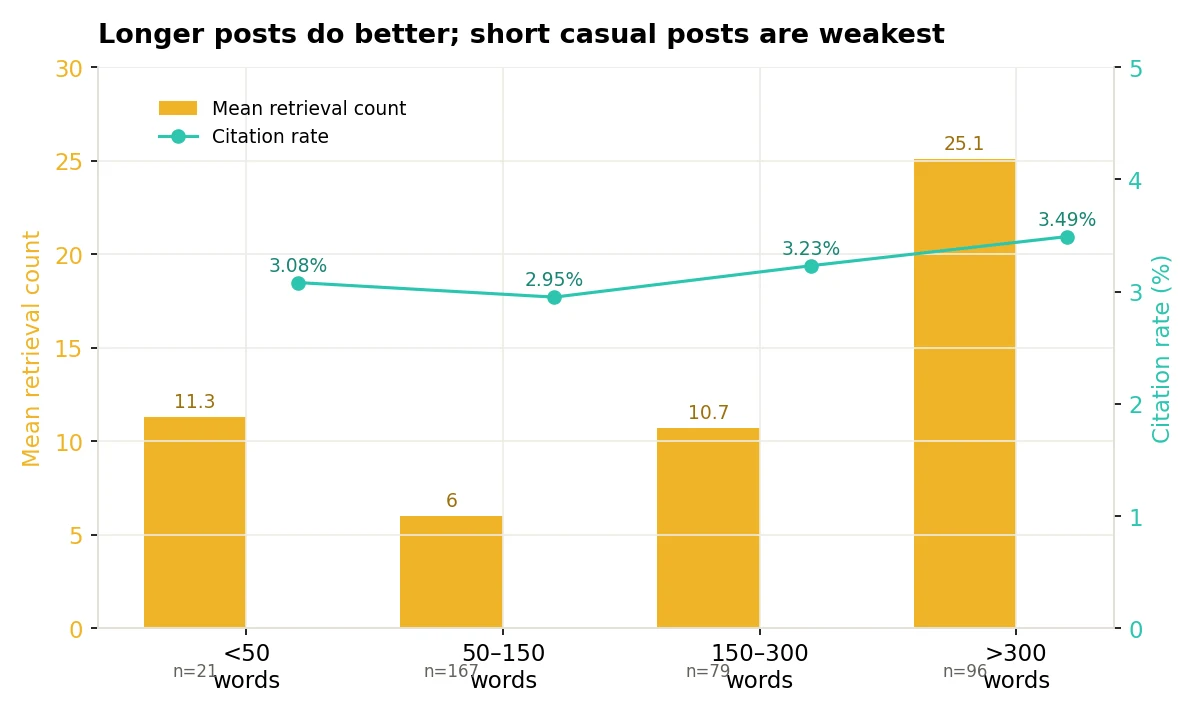
The casual-post belief does not hold up against these numbers. The short, chatty post was doing worst, and the longer, list-structured post was doing best on both measures. For a team chasing golden posts, these three features are the safe foundation.
The features that raise only one
Other features helped one measure and not the other, which makes them traps for anyone trying to hit both.
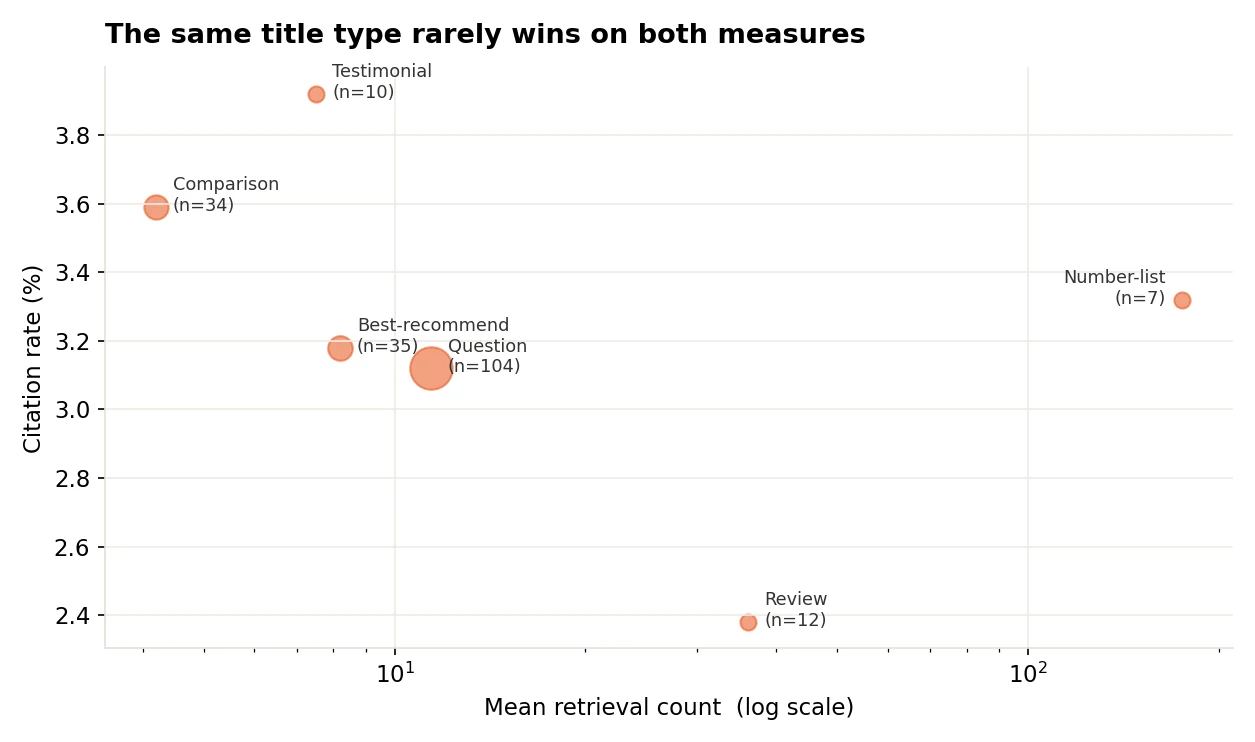
Title type was the clearest case. Number-list titles, the “5 best” kind, had the highest retrieval of any format at 175.1, but only 3.32% citation across 7 posts. Testimonial titles were the mirror image. They had the highest citation rate, 3.92%, on the lowest retrieval, 7.5, across 10 posts.
Comparison titles were the most balanced, at 4.2 retrieval and 3.59% citation across 34 posts. Ranked by retrieval, the title order almost flips when you rank by citation.
Competitor mentions split the same way. By a body mention I mean a post that names rival tools while making its point, like a thread weighing one note-taker against two others.
Naming one competitor moved both up, retrieval by 67.3 and citation by 0.77%. Another added 0.42% to citation but dropped retrieval by 8.6. A third pushed retrieval up 27.5 while cutting citation by 0.81%. The direction depended on the brand. With such small per-brand counts, I would treat these as leads to test, not rules.
Where golden posts cluster
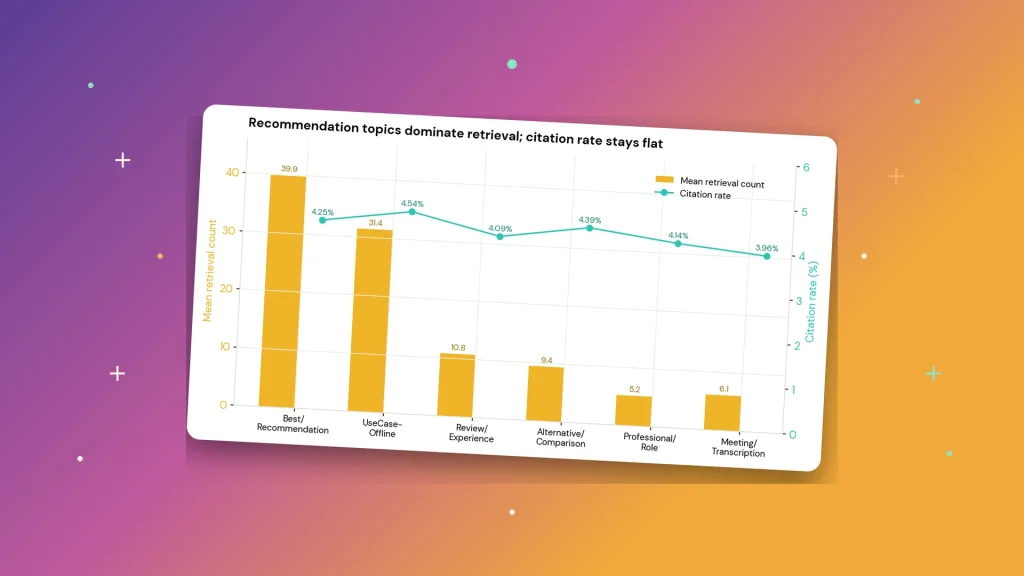
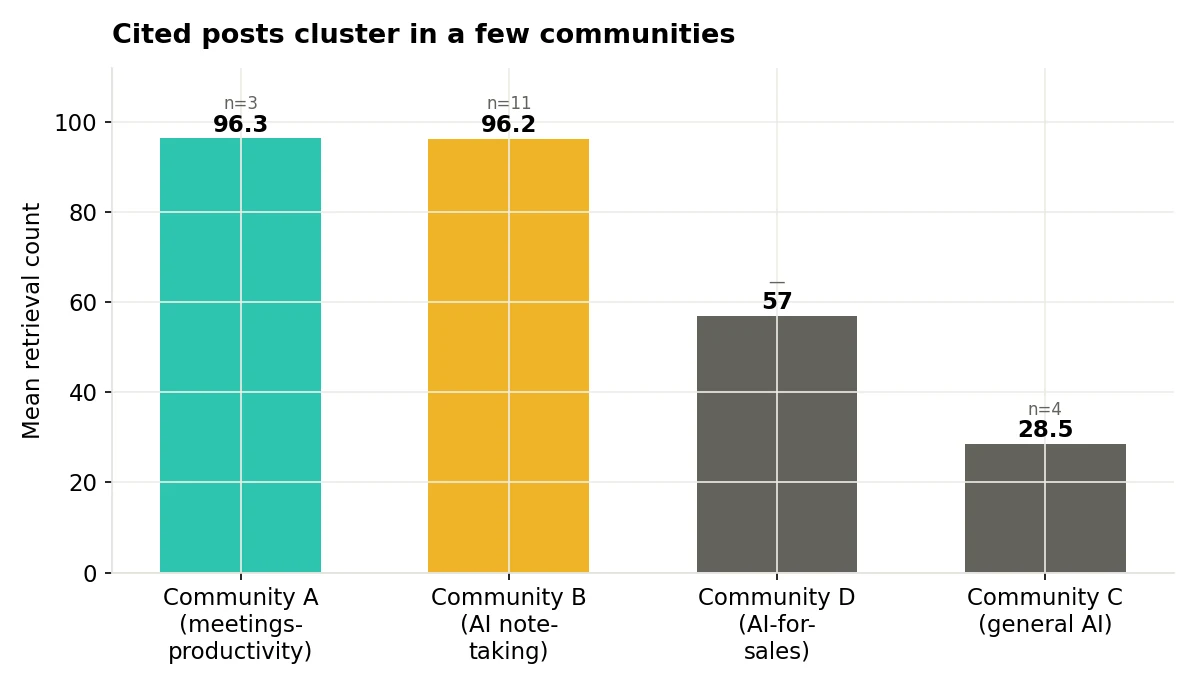
Two communities carried both measures. A meetings-productivity community averaged 96.3 retrieval and 3.87% citation. A general AI community averaged 28.5 retrieval and 3.99% citation. The Best and Recommendation topic led on both, at 39.9 retrieval and 4.25% citation across 84 posts.
Put those features together and the typical golden post has a recognizable shape. It is a comparison or recommendation post of more than 300 words, with a list, published in one of these communities, and three to four months old.
For Part A, the practical move is to build longer, structured posts and place them early, so they mature into the 90 to 180-day window. Treat title and competitor choices as trade-offs, not free wins.
Part B: what maximizes retrieval on its own
Part B ignores citation and asks a narrower question. If the goal is just to be pulled into the candidate set, which features move retrieval the most?
This matters because retrieval comes first. A post has to be retrieved before it can be cited.
And even when it is not cited, a retrieved post that mentions a brand can still feed that brand into the model as it drafts an answer. That is the basic form of visibility Part B is about, and it does not depend on the post ever showing up as a link.
Title match is the strongest lever
Matching the title to the prompt moved retrieval more than anything else. Posts whose titles closely matched the prompt averaged 102.2 retrieval across 14 posts. That is about 22 times the 4.6 average of posts with no clear match.
Number-list titles pushed retrieval even higher, to 175.1 on average, close to five times the next format. These formats mirror how a Best-class query is phrased, and that surface match is what pulls them in.
The highest-retrieval communities and topics
Retrieval was concentrated in a handful of communities, and a couple of them pulled far ahead of the rest.
An AI note-taking community had the strongest pull, at 96.2 average retrieval and the highest total in the sample, above 1000. A meetings-productivity community was just behind at 96.3. An AI-for-sales community reached 57, and a general AI community sat at 28.5.
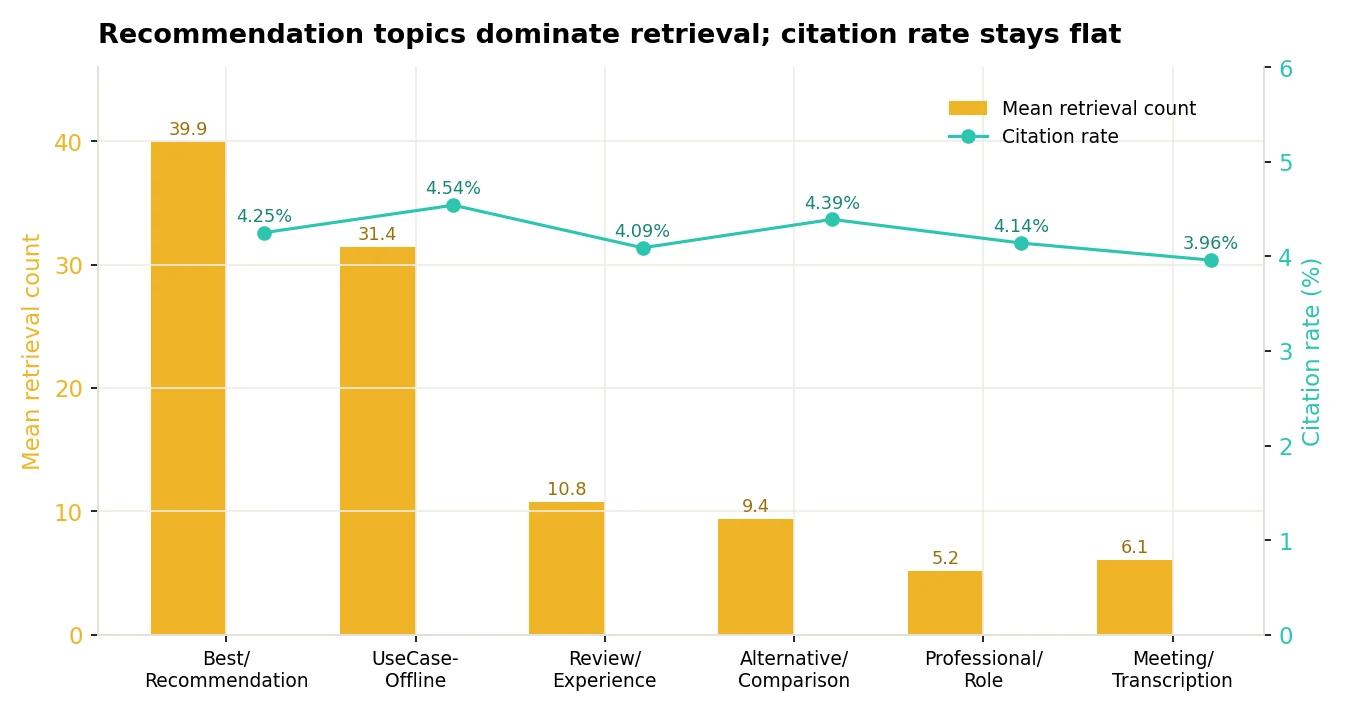
By topic, Best and Recommendation led at 39.9 retrieval, with UseCase-Offline next at 31.4. In the chart, the citation line barely moves while retrieval swings widely across topics.
Longer content and competitor names help too
Length matters for retrieval too. Posts over 300 words averaged 25.1 retrieval, roughly four times the 6.0 of the 50 to 150-word group. Posts with lists reached 18.8 against 9.2 without.
Competitor names in the body also drove retrieval up. Posts that mentioned rivals in the body averaged 25.6, against 7.4 for posts that did not. That is about three and a half times higher.
The practical read of Part B is that retrieval responds to surface match. A post gets pulled in far more often when its title lines up with the query and it names the tools people compare, even if it is never cited.
Possible explanations
The data does not confirm why these patterns exist, but two explanations fit what I saw.
Retrieval appears tied to how closely a post matches the query. The features that raised it most, strong title match and list-style formats, are the ones that read like a direct answer to a Best-class prompt.
Citation appears tied to the content itself rather than to surface match. Testimonial titles and first-person experience did better on citation while doing poorly on retrieval, which hints that the model may cite what reads as credible first-hand evidence.
That gap is why the two parts rarely point to the same tactic. The study identifies associations in a snapshot of cited posts, not internal ranking rules, and the outcome may also depend on account, location, and prompt wording that this data does not isolate.
What this means for Reddit and GEO teams
The two parts lead to two playbooks, and a team should pick based on the goal it is measuring.
If the goal is retrieval reach
Use the Part B levers. Match titles to the queries you want to appear for, write longer structured posts, and mention the tools people compare. Expect this to increase how often you are pulled in, not how often you are cited.
If the goal is being cited too
Lean on the Part A features that move both, meaning length, lists, and post age. Treat number-list titles and competitor mentions as trade-offs, because they can push retrieval up while leaving citation flat.
Either way, separate the two metrics
The clearest lesson is to stop treating retrieval as a proxy for citation. Track them apart, and decide which one a given post is meant to win before writing it.
Limitations
- The sample is drawn entirely from posts ChatGPT had already cited. It describes variation among surfaced posts and cannot explain what separates cited from never-cited posts.
- The analysis covers one platform, ChatGPT, through one vendor, SparkToro.
- Several breakdowns rest on small cells, some with fewer than 10 posts.
- The study covers United States, English, and 100 Best-class prompts only. It does not generalize to other markets, languages, or query types.
- The analysis identifies correlations, not proven causes, and reflects a snapshot in time.
Conclusion
Splitting the study into two parts made the core pattern easier to see. Part A showed that only 135 of 363 posts were both retrieved and cited. The two measures agree on just a few features, mainly length, lists, and post age. Part B showed that retrieval on its own responds most to title-to-prompt match and list-style formats.
The more useful takeaway is that these are two different goals with two different playbooks. A post has to be retrieved before it can be cited, and the tactics that push retrieval up often do nothing for citation.
For now, the evidence supports building longer, structured content in a focused set of communities, and measuring retrieval and citation separately. The next step is to test these patterns against a control group of never-cited posts, and across markets beyond US English.

Written by
Marketing enthusiast with a passion for SEO and Generative Engine Optimization (GEO). I believe SEO and GEO are ultimately about running experiments, testing hypotheses, learning from data, and building repeatable strategies that drive sustainable growth. I'm passionate about turning insights into practical frameworks, scaling what works, and continuously exploring how AI is reshaping search and digital marketing.